

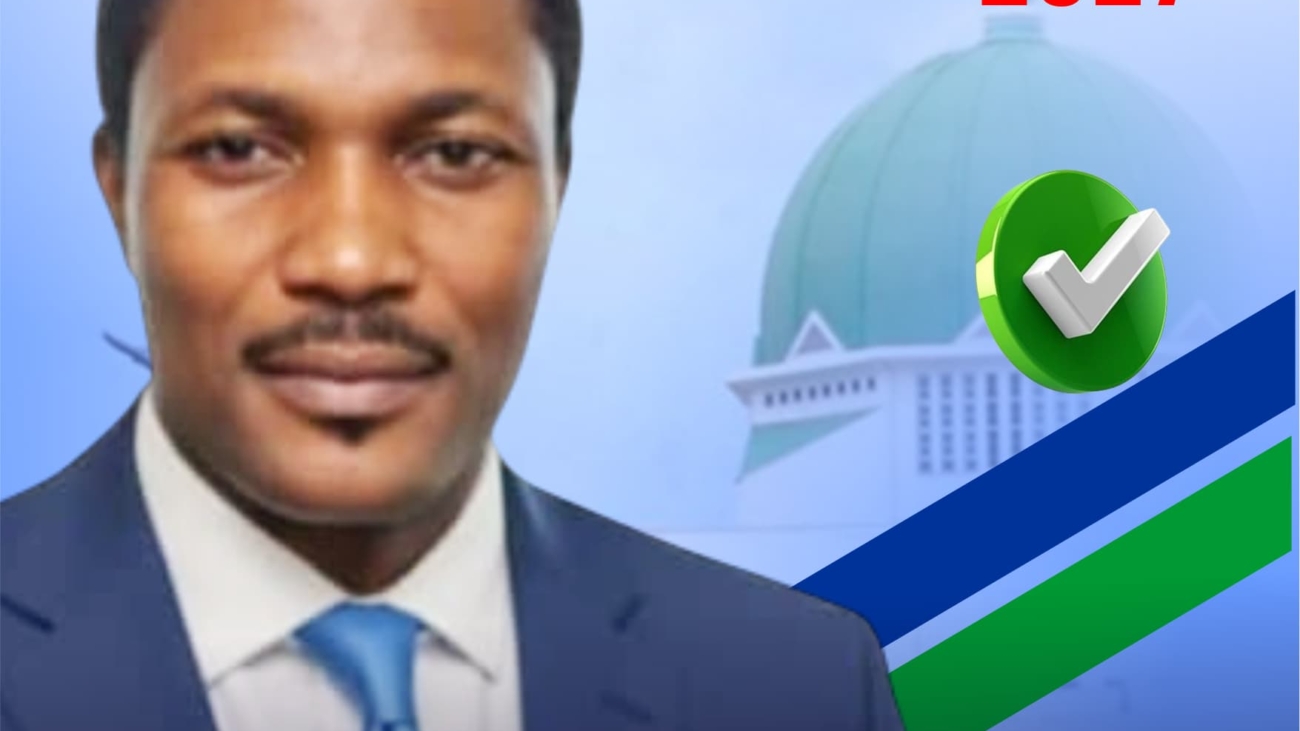
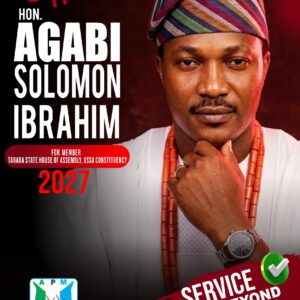

The APM candidate for Ussa State Constituency is offering a new vision of legislative representation anchored on youthful leadership, grassroots mobilisation, community empowerment, security, infrastructure and accountable governance.
As political activities gradually gather momentum ahead of the next electoral cycle in Taraba State, Agabi Solomon Ibrahim, the Allied Peoples Movement (APM) candidate for Ussa Constituency in the Taraba State House of Assembly, is presenting a compelling vision for purposeful leadership and sustainable development in Ussa Local Government Area.
A youthful, sociable and people-friendly personality, Ibrahim represents a generation of aspiring political leaders seeking to combine fresh ideas, community engagement and practical development initiatives with effective legislative representation.
His growing grassroots popularity and connection with the people reflect a political identity built around accessibility, social interaction and an understanding of the everyday challenges confronting ordinary residents. As a young leader who has demonstrated capacity and contributed to community development, he is seeking to translate that experience and grassroots connection into a stronger platform for public service.
His political philosophy is captured in his campaign theme: “SERVICE BEYOND PROMISE: Elevating Ussa Through Action, Equity, and Accountability.”
The central message of his aspiration is that representation must go beyond occupying a legislative seat. It must translate into effective advocacy, measurable development, accessible leadership and tangible improvements in the lives of the people.
For Ibrahim, the legislature should not merely be an institution where political positions are occupied, but a platform through which the aspirations, concerns and development priorities of ordinary people receive meaningful attention.
A LEGISLATOR WHO WILL GIVE THE PEOPLE A VOICE
At the heart of Ibrahim’s vision is a commitment to proactive legislative advocacy and inclusive governance.
He believes the people of Ussa deserve representation that actively sponsors development-oriented legislation, pursues strategic government interventions and consistently champions the constituency’s interests at the state level.
His manifesto outlines a commitment to advocating for legislation and government policies that guarantee improved resource allocation, infrastructure investment and targeted security interventions for Ussa.
To strengthen communication between the legislature and the grassroots, he proposes establishing accessible constituency feedback offices across Ussa, creating platforms through which residents can communicate their concerns and development priorities.
He also plans to institutionalise quarterly town hall meetings where constituents will receive updates on legislative activities, discuss emerging challenges and evaluate progress on campaign commitments.
This approach places accountability at the centre of representation, ensuring that the people remain active participants in decisions affecting their communities.
SECURITY AND PEACE: THE FOUNDATION OF DEVELOPMENT
Recognising the security challenges confronting communities in Ussa, particularly vulnerable border settlements, Ibrahim identifies peacebuilding and community security as fundamental priorities.
His manifesto proposes sustained advocacy for increased logistical support, funding and equipment for local security structures, including vigilantes, hunters and joint security task forces working to protect lives and property.
Beyond immediate security responses, he recognises the importance of addressing the underlying causes of communal and border tensions.
He therefore intends to work with traditional institutions, community leaders and elders to promote dialogue, strengthen conflict-resolution mechanisms and prevent disputes from escalating into violence.
Particularly significant is his commitment to advocating for urgent state and federal interventions for internally displaced persons, the rehabilitation of affected communities and the safe return of displaced residents to their ancestral homes.
For Ibrahim, no meaningful development can take place where communities live under constant fear or where families are unable to return to their homes.
CONNECTING USSA THROUGH STRATEGIC INFRASTRUCTURE
Infrastructure development occupies another major position in Ibrahim’s development agenda.
He argues that Ussa’s agricultural and economic potential cannot be fully realised without functional roads, reliable electricity and access to clean water.
His manifesto promises aggressive legislative lobbying for the rehabilitation and reconstruction of critical roads connecting Ussa to neighbouring local government areas.
Improved road networks, according to his vision, will reduce transportation difficulties, facilitate the movement of agricultural produce, strengthen commercial activities and improve access to essential services.
On water supply, he proposes supporting the construction and rehabilitation of solar-powered boreholes across vulnerable wards, particularly communities experiencing persistent water shortages.
His infrastructure agenda also includes advocating for improved rural electrification, community-level electricity maintenance and solar-powered streetlights to strengthen security and support commercial activities, especially in rural markets.
These interventions are intended to address practical challenges that directly affect household welfare and economic productivity.
ECONOMIC EMPOWERMENT: TURNING AGRICULTURAL POTENTIAL INTO PROSPERITY
With agriculture serving as a major economic activity in Ussa, Ibrahim’s manifesto places considerable emphasis on empowering farmers, supporting small businesses and creating opportunities for young people.
He proposes advocating for the timely distribution of subsidised fertilisers, improved seedlings and modern agricultural equipment to genuine local farmers.
The objective is to strengthen agricultural productivity, reduce production difficulties and improve the economic position of farming households.
For women, particularly market traders and small-scale agricultural processors, his vision includes establishing a revolving empowerment fund that would provide interest-free microloans to support businesses and expand economic opportunities.
His youth empowerment agenda is equally ambitious.
He proposes establishing a vocational and skills acquisition centre in Ussa, offering practical training in information and communication technology, carpentry, mechanical fabrication, fashion design and other income-generating skills.
The initiative is designed to equip young people with marketable skills, encourage entrepreneurship and reduce unemployment and youth restiveness.
Rather than promoting dependency, Ibrahim’s economic philosophy emphasises providing people with the tools, opportunities and support required to become financially productive.
INVESTING IN EDUCATION AND HEALTHCARE
Ibrahim’s manifesto recognises that the true measure of development is not limited to roads and physical infrastructure but must also include investments in human capital.
On healthcare, he promises to champion the revitalisation of Primary Healthcare Centres across Ussa’s wards through improved facilities, adequate staffing, essential medicines and better service delivery.
His position is that access to basic healthcare should not depend on a family’s financial circumstances or geographical location.
In education, he proposes annual scholarship and educational intervention programmes for students from disadvantaged backgrounds, particularly those pursuing studies in tertiary institutions.
He also intends to advocate for the renovation of dilapidated primary and secondary school buildings, alongside improvements in the learning environment across rural communities.
These proposals reflect his belief that education and accessible healthcare are fundamental investments in the future of Ussa.
YOUTHFUL LEADERSHIP, GRASSROOTS CONNECTION AND PEOPLE-CENTRED GOVERNANCE
Beyond the specific development proposals contained in his manifesto, Ibrahim’s political aspiration is strongly associated with his identity as a youthful and community-oriented leader.
His sociable disposition, accessibility and ability to relate with people across different backgrounds form important aspects of the leadership image he is presenting to the electorate.
His grassroots appeal is built around the understanding that leadership is fundamentally about people. A representative must be accessible not only during election campaigns but throughout the period of service.
As an APM candidate, he is seeking to bring youthful energy, fresh perspectives and a stronger culture of community engagement into the Taraba State House of Assembly.
His aspiration is to build a representation where traditional institutions, community stakeholders, women, youths, farmers, traders and other groups have opportunities to contribute to decisions affecting their future.
For him, effective leadership requires listening, consultation, accountability and the determination to turn community needs into actionable development priorities.
SERVICE, ACCOUNTABILITY AND A NEW STANDARD OF REPRESENTATION
Perhaps the most defining aspect of Agabi Solomon Ibrahim’s manifesto is his proposed approach to public service.
His campaign theme, “Service Beyond Promise,” reflects an attempt to establish a standard of representation in which leadership is measured not by campaign speeches, political titles or public appearances, but by commitment, accessibility, accountability and demonstrable results.
The proposed quarterly town halls, constituency feedback offices and development-focused legislative advocacy are intended to create a system in which constituents can continually engage their representative and assess the progress of commitments made to them.
His pledge is to make the interests of Ussa central to his legislative responsibilities and ensure that the constituency receives sustained attention in the state’s development conversations.
While successful implementation of these proposals will depend on legislative authority, budgetary provisions, executive collaboration and effective partnerships with relevant institutions, Ibrahim’s manifesto provides a framework for pursuing these priorities through the opportunities available to a state legislator.
THE PROMISE: A REPRESENTATION THAT DELIVERS
For Agabi Solomon Ibrahim, the aspiration is to build a legacy defined by service rather than political convenience.
He maintains that the people of Ussa deserve a representative who listens, understands their challenges, speaks for their interests and remains accountable throughout the period of representation.
His commitment is captured in the concluding pledge of his manifesto:
“Promises are easy to write, but service is proven through action. My representation will not hide behind legislative bureaucracy. I solemnly pledge to the good people of Ussa LGA that my time in the Taraba State House of Assembly will be defined by visible projects, accessible leadership and a steadfast commitment to delivering Service Beyond Promise.”
As the political journey towards the Taraba State House of Assembly unfolds, the APM candidate is placing before the people a vision that combines youthful leadership, grassroots connection, community experience and a comprehensive development agenda.
Ultimately, the people of Ussa will determine the leadership they desire and the future they want to build.
But for Agabi Solomon Ibrahim, the message of his political aspiration is clear: Ussa deserves more than representation. It deserves purposeful leadership, a strong legislative voice, inclusive governance and a commitment to development that can be seen and felt across communities.
AGABI SOLOMON IBRAHIM
APM CANDIDATE FOR TARABA STATE HOUSE OF ASSEMBLY
USSA CONSTITUENCY
SERVICE BEYOND PROMISE!
Elevating Ussa Through Action, Equity, and Accountability.

Leave A Comment