



A medical doctor, public administrator and former Commissioner for Finance takes his experience in healthcare, governance and development into the contest for the Senate
By NewsNexus
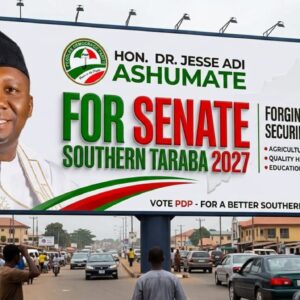
Dr. Jesse Adi Ashumate is entering the 2027 race for the Taraba South Senatorial District with a career spanning medicine, public administration, financial management, community development and private enterprise.
A member of the Peoples Democratic Party (PDP), Ashumate is the party’s candidate for Taraba South. His name appears on the published list of candidates for the 2027 National Assembly election in the district.
His candidacy is notable not only because he is seeking elective office at the federal level, but also because he is attempting to translate a career built largely outside the legislature into a programme of political representation.
From Medicine to Public Service
Ashumate’s professional background is rooted in medicine and public health.
He studied Medicine and Surgery at Ahmadu Bello University and subsequently obtained a Master’s degree in Public Health from the University of Nigeria. He also undertook postgraduate medical training leading to fellowship of the West African College of Physicians, with professional experience that included responsibilities in healthcare administration.
He later became associated with the Federal University Wukari, where he served as Medical Director and was involved in the development of the institution’s health services.
A published academic paper on healthcare delivery lists Adi Jesse Ashumate among its authors and identifies him with the Department of Health Services at the Federal University Wukari, providing independent evidence of his professional and academic engagement in health-service research.
His supporters also credit him with helping establish the university’s health centre and introducing a health-insurance initiative intended to extend healthcare access to staff and surrounding communities.
From Healthcare to Public Finance
Ashumate’s transition from medicine into government administration marked another significant phase of his career.
Under former Governor Darius Dickson Ishaku, he served as Commissioner for Finance and Economic Planning.
His tenure placed him at the centre of the state’s financial administration, including budgeting, revenue, expenditure management and economic planning.
Official Taraba State financial documents from the period identify Dr. Jesse Adi Ashumate as Commissioner for Finance. The state’s 2021 and 2022 financial reports, for example, carry his name in that capacity.
His period in government also coincided with Taraba’s participation in the World Bank-supported State Fiscal Transparency, Accountability and Sustainability (SFTAS) programme.
Ashumate’s supporters attribute part of the state’s engagement with the programme to his administration and point to reforms involving fiscal transparency, accountability, revenue mobilisation and public financial management.
His public-sector profile also includes involvement in the development of the Taraba Geographic Information System (TAGIS), an initiative aimed at modernising aspects of land administration and property documentation.
Community Development and the CSDP
Another area associated with Ashumate’s public-service record is the Community and Social Development Project (CSDP).
Supporters say he played a role in the reactivation and institutional development of the programme in Taraba State, including the establishment of its operational structures.
The programme subsequently supported community-level interventions involving education, healthcare, water supply, agriculture, livelihoods and other social infrastructure.
Claims that more than 250 community projects were implemented during this period have been widely cited in accounts of his record, although individual project numbers and attribution should be assessed against official CSDP records before being presented as independently verified figures.
Youth Empowerment and Employment
Youth employment and economic empowerment have become central themes in Ashumate’s political message.
Supporters point to employment opportunities they say he helped facilitate for young people through institutions and programmes associated with the Federal University Wukari, CSDP and other government initiatives.
His supporters also cite assistance to young people seeking opportunities in federal institutions and security agencies.
These claims form part of the broader argument advanced by his campaign that his public-service experience has involved not only policy and administration but also direct engagement with employment and livelihood challenges.
Business and Private Enterprise
Beyond government, Ashumate has developed interests in the private sector.
He is associated with the Kwararafa Group and Ismida Petroleum Company, through which his supporters say he has been involved in cement distribution, petroleum-related business and other commercial activities.
Accounts of his business activities describe support for distributors and entrepreneurs in parts of Southern Taraba, including Wukari, Ibi, Donga, Takum and Ussa.
Supporters also cite business-training and empowerment initiatives involving young people and market women, including training in basic healthcare, business management, record keeping and small-enterprise development.
Claims concerning the scale and number of beneficiaries, however, remain primarily campaign- or supporter-supplied and should be distinguished from independently audited impact data.
A Candidate With No Legislative Experience
One defining feature of Ashumate’s candidacy is that he has not previously served as a member of the National Assembly.
His political proposition therefore rests substantially on transferring experience acquired in other sectors into legislative representation.
His supporters argue that his background in medicine, public finance, economic planning, institutional management and business gives him experience relevant to the Senate’s responsibilities in legislation, oversight, representation and engagement with federal agencies.
The counterpoint is equally important for voters to consider: executive and administrative experience is different from legislative experience, and a Senate seat requires understanding of parliamentary procedure, lawmaking, committee work, oversight and constituency representation.
That distinction is part of the wider public debate surrounding candidates entering the 2027 National Assembly elections.
What Ashumate Says He Would Prioritise
In August 2026, Ashumate publicly outlined some of the priorities of his proposed legislative agenda.
Speaking alongside PDP candidate for Wukari/Ibi Federal Constituency, TPL Mukhtar Usman Galadima, he identified youth empowerment, agriculture, entrepreneurship and employment as major areas of focus.
He argued that greater attention to agriculture could create economic opportunities for young people across Southern Taraba.
He also identified peace and unity among communities in the senatorial district as important priorities, particularly in view of the history of communal tensions and insecurity in parts of the area.
The broader agenda presented by the PDP candidates includes infrastructure, healthcare, employment, youth and women’s empowerment and peace-building.
Ashumate has also said that effective representation should involve dialogue, collaboration and engagement with government agencies and other stakeholders to attract development to the district.
Campaigning on Accountability
Ashumate formally commenced his Taraba South Senate campaign in Wukari in September 2026.
At the campaign flag-off, he placed accountability and transparency among the central themes of his campaign and raised questions concerning government-funded projects and programmes in Southern Taraba.
Among the issues he raised were funds he alleged had been allocated for the Bete Road project and funding reportedly earmarked for women’s training programmes.
Those allegations concern public expenditure and should be treated as allegations unless supported by official budget, procurement, implementation or audit records. Contemporary reports also noted that the claims could not independently be verified at the time.
The episode nevertheless illustrates an emerging feature of his campaign: an attempt to make accountability and scrutiny of public projects part of the political conversation in Taraba South.
The Taraba South Constituency
Taraba South comprises Wukari, Ibi, Donga, Ussa, Takum and Kurmi, making it one of the state’s geographically and politically significant senatorial districts.
The zone possesses substantial agricultural, commercial and natural-resource potential but also faces longstanding challenges involving roads, healthcare, education, employment, insecurity and access to infrastructure.
For a senator representing the district, therefore, the responsibilities would extend beyond making laws. They would include representation in Senate committees, oversight of federal institutions and programmes, advocacy for constituency interests, engagement with ministries and agencies, and the pursuit of policies and projects relevant to the district.
A Different Route to the Senate
Ashumate’s career presents an unusual route into national politics.
Rather than rising through a long legislative career, he has moved from medicine to healthcare administration, from healthcare administration to public finance and government, and from government into private enterprise and political contestation.
That background provides both the central argument for his candidacy and an issue for voters to examine.
His supporters see his experience across several sectors as evidence of administrative breadth, professional networks and familiarity with government institutions.
His opponents and political observers will inevitably scrutinise his record in office, business interests and policy positions as the campaign develops.
For the electorate, the relevant questions include what he achieved in previous positions, what he proposes to do differently in the Senate, how measurable his proposed agenda is, and how he intends to translate promises into legislative action.
The 2027 Senate Contest
As of September 2026, Ashumate is one of the candidates listed for the Taraba South Senate election. The published candidate list contains 10 candidates contesting the seat, including the incumbent senator, David Jimkuta of the APC.
The contest will therefore place Ashumate’s record, political platform and legislative agenda alongside those of other candidates seeking the same seat.
His campaign has so far emphasised youth employment, agriculture, entrepreneurship, peace, accountability and development.
Whether those priorities ultimately translate into detailed legislative proposals, measurable commitments and sustained constituency engagement will be among the issues that voters can examine during the campaign.
A Profile Built Around Experience
Dr. Jesse Adi Ashumate enters the 2027 Taraba South Senate race with a professional history that cuts across medicine, public health, university administration, public finance, economic planning, community development and private enterprise.
His candidacy is consequently being presented by his supporters as a bid to bring technocratic and administrative experience into the legislative arena.
But ultimately, a Senate campaign is not only about a candidate’s résumé. It is also about policy priorities, legislative capacity, accountability, constituency engagement and the ability to articulate how national legislation and federal oversight can address local challenges.
For Taraba South, the 2027 election will provide an opportunity for voters to examine Ashumate’s record, compare his stated agenda with those of the other candidates, and determine the kind of representation they want for the district at the National Assembly.

Leave A Comment