

By NewsNexus Fact Check Desk
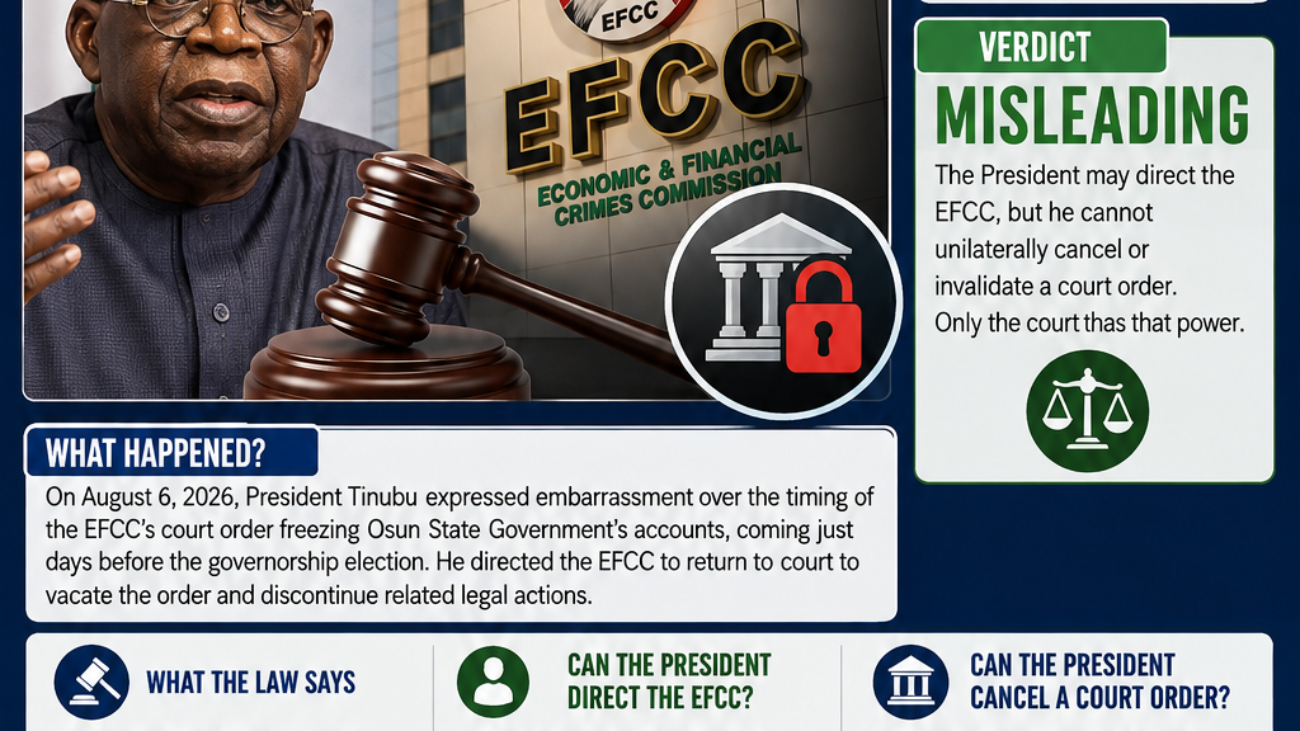
Claim: President Bola Ahmed Tinubu acted outside his constitutional powers by directing the Economic and Financial Crimes Commission (EFCC) to return to court and vacate the order restricting the Osun State Government’s bank accounts.
Verdict: MISLEADING
The claim is misleading because it confuses the President’s executive supervisory authority over federal agencies with the judiciary’s exclusive power to make or set aside court orders.
What Happened?
On August 6, 2026, President Bola Tinubu publicly stated that he was “deeply embarrassed” by the timing of the EFCC’s decision to obtain a court order restricting the Osun State Government’s bank accounts, noting that the action came just days before the state’s governorship election. He subsequently directed the EFCC to immediately return to court to seek the vacation of the order and discontinue related legal proceedings.
What Does the Law Say?
Under Section 5 of the Constitution of the Federal Republic of Nigeria, 1999 (as amended), the executive powers of the Federation are vested in the President. These powers include the general supervision of ministries, departments, and agencies of the Federal Government.
The EFCC, however, is established under the Economic and Financial Crimes Commission (Establishment) Act, 2004. While it is expected to perform its investigative and prosecutorial functions independently and without political interference, it remains a federal executive agency.
Can the President Direct the EFCC?
Yes—but only within constitutional limits.
The President may issue executive or policy directives to federal agencies, including the EFCC. Therefore, directing the EFCC to reconsider its legal position and apply to the court to vacate an order is within the scope of executive supervision.
However, the President cannot personally cancel or invalidate a court order. Once a court has granted an order, only that court—or a higher court on appeal—has the legal authority to set it aside.
This means that although the President may instruct the EFCC to return to court, the final decision rests entirely with the judiciary.
Why the Distinction Matters
The President’s directive does not automatically nullify the court order. Instead, it requires the EFCC to file an application before the court requesting that the order be vacated. The court is free to either grant or refuse that request based on the law and the evidence before it.
Therefore, the President cannot compel the judiciary to lift the restriction.
NewsNexus Assessment
Based on the Constitution and the legal framework governing the EFCC:
– The President may supervise and issue directives to the EFCC as a federal executive agency.
– The President cannot unilaterally revoke or overturn a court order.
– Only the court has the constitutional authority to vacate the order if the EFCC applies for such relief.
Final Verdict
MISLEADING.
It is inaccurate to claim that President Tinubu acted outside the law merely because he directed the EFCC to return to court. Such a directive falls within the executive’s supervisory authority. However, the President has no legal power to personally cancel a court order, as that remains the exclusive constitutional responsibility of the judiciary.

Leave A Comment