

By Abraham Maina Joda
Why dragging Rev. Ezekiel Dachomo into the conversation does not answer the questions raised by Sheikh Sani Yahaya Jingir’s remarks
By Abraham Maina Joda
There is something deeply troubling about the way public discourse around religion and politics in Nigeria often degenerates into a competition over who said something worse, rather than a sincere examination of what has actually been said.
The latest controversy surrounding remarks attributed to Sheikh Sani Yahaya Jingir provides another example.
Instead of engaging directly with the substance of the Sheikh’s comments, some commentators have quickly resorted to bringing up remarks previously attributed to Rev. Ezekiel Dachomo during the debate over alleged Christian genocide in Nigeria.
That response deserves to be questioned.
Why are we bringing Rev. Ezekiel Dachomo into this conversation?
If Sheikh Jingir’s comments are considered right, defend them. Explain why they are right. If they are considered wrong, condemn them. Explain why they are wrong.
But bringing up something Rev. Ezekiel Dachomo said in the past does not answer the question before us today.
It is whataboutism.
And whataboutism is particularly dangerous when the subject is religion.
Deal With the Issue Before You
A mature society must be capable of holding two thoughts simultaneously.
It is entirely possible for someone to believe that Rev. Ezekiel Dachomo made an inappropriate or divisive statement in the past and simultaneously believe that Sheikh Jingir’s current remarks should be scrutinised and criticised if they are problematic.
One does not cancel out the other.
If Rev. Dachomo was wrong, then he was wrong. Say so.
If Sheikh Jingir is wrong, then he should equally be called out.
There is no principle that says a person’s questionable statement becomes acceptable simply because somebody else made a questionable statement at another time.
That is not accountability. It is scorekeeping.
And religion should not become a football match where every uncomfortable statement from one side is answered by digging up an uncomfortable statement from the other side.
The Dangerous Question: “But What About Dachomo?”
The question we should be asking is not:
“What did Rev. Ezekiel Dachomo say?”
The question is:
“What exactly did Sheikh Jingir say, what did he mean in its context, and is that position helpful or harmful to Nigeria’s already fragile religious and political environment?”
Those are the questions that deserve answers.
If the Sheikh’s defence of a Muslim-Muslim ticket is the issue, then let us debate Muslim-Muslim tickets.
If his characterisation of those who oppose his position is the issue, then let us examine that language.
If his claims about Nigeria’s religious demographics are the issue, then let us demand credible data.
If his argument is that Muslims have the same right as Christians or other religious groups to organise politically around their identity, then let us examine that argument honestly.
But dragging Rev. Ezekiel Dachomo into the discussion does none of these things.
It simply changes the subject.
For the Avoidance of Doubt
Let me make this clear: this is not an article in support of Rev. Ezekiel Dachomo, nor am I pretending to be one of his uncritical supporters.
I have, in the past, openly criticised Rev. Dachomo for what I considered to be overly sentimental and, at times, excessively sensational expressions, even though I understand the pain and trauma behind some of his pronouncements.
He has buried hundreds of his parishioners and fellow Christians in Plateau State, and that reality is something no reasonable person should dismiss or trivialise.
However, understanding someone’s pain does not mean agreeing with everything they say.
I have disagreed with Rev. Dachomo before, and I have no difficulty doing so again whenever I believe he is wrong.
That is precisely why my argument here should not be interpreted as an attempt to defend him.
The issue is the unnecessary “what about” argument.
If people believe Rev. Dachomo was wrong in the past, I have no problem with them saying so. But bringing up his past statements every time Sheikh Jingir is being questioned does not make Sheikh Jingir’s current position right or wrong. It merely diverts attention from the matter at hand.
I am not defending Rev. Dachomo. I am defending consistency.
If we genuinely believe in accountability, then we must apply the same standard to everyone — Muslim or Christian, cleric or politician, friend or opponent.
We cannot condemn a statement today by saying, “But your man said something similar yesterday.”
That is precisely the kind of argument that prevents meaningful conversation and keeps Nigeria trapped in an endless cycle of religious scorekeeping.
Judge each statement on its own merit. That is the only fair standard.
You Cannot Defend a Statement by Pointing to Somebody Else’s Statement
This is where the hypocrisy becomes particularly obvious.
Imagine two people standing before a court.
One is accused of wrongdoing. His defence is not to demonstrate that he did nothing wrong, but to point at another person and say:
“But he also did something wrong.”
That does not establish innocence.
The same principle applies to public discourse.
If someone believes Sheikh Jingir’s comments were appropriate, the honest position is to defend the comments.
Do not hide behind Rev. Ezekiel Dachomo.
And if someone believes the Sheikh’s comments were inappropriate, then condemn them without qualification.
Do not soften your condemnation by immediately saying, “But Rev. Dachomo also said something.”
Both approaches are intellectually weak.
Religious Accountability Cannot Be Selective
Nigeria desperately needs a culture in which religious leaders and public figures are judged by the same standard, regardless of whether they are Muslim or Christian.
When a Christian cleric makes a provocative statement, Muslims should be able to condemn it without being accused of attacking Christianity.
When a Muslim cleric makes a provocative statement, Christians should be able to condemn it without being accused of attacking Islam.
And when either side is wrong, the wrong should not be defended simply because the person belongs to “our side.”
That is the real test of sincerity.
Otherwise, what we are practising is not principle but tribal and religious partisanship.
The Dachomo Controversy Can Be Discussed — But Separately
This does not mean Rev. Ezekiel Dachomo’s previous comments should never be discussed.
They can and should be examined if they are relevant to a separate discussion about religious rhetoric, Christian leadership, allegations of genocide, or the language used during periods of insecurity.
But that discussion should stand on its own.
If people believe Rev. Dachomo was wrong, they should say so clearly.
If they believe he was misunderstood or taken out of context, they should provide the context.
If they believe his position was justified, they should defend it.
But none of those arguments answers the question about Sheikh Jingir.
Two wrongs do not produce a right.
Nigeria Cannot Survive Endless Religious Scorekeeping
Our country already has enough religious suspicion, ethnic distrust and political manipulation.
We should therefore be extremely careful about turning every religious controversy into an opportunity to remind one another of the sins of the other side.
That road leads nowhere.
It creates a dangerous cycle:
A Muslim cleric says something controversial.
Someone condemns him.
His supporters respond by producing an old statement from a Christian cleric.
Christians respond by producing another statement from a Muslim cleric.
The original issue disappears.
Nobody accepts responsibility.
And the public is left with nothing except deeper resentment.
This is precisely the kind of cycle responsible citizens, journalists, religious leaders and political actors should be trying to break.
Let Us Be Honest
If Sheikh Sani Yahaya Jingir’s comments are defensible, defend them.
If they are indefensible, condemn them.
If there is context that changes their meaning, provide the context.
If there are factual claims that can be verified or disproved, provide the evidence.
But please, do not bring Rev. Ezekiel Dachomo into the conversation simply to distract Nigerians from dealing with the Sheikh’s own words.
And the same standard must apply when the situation is reversed.
When Rev. Ezekiel Dachomo or any Christian leader makes a controversial statement, Muslims should not be allowed to escape the substance of that statement by pointing to another Christian or by claiming that a Muslim cleric once said something worse.
That is not accountability. That is hypocrisy.
Nigeria needs fewer people defending their religious camp at all costs and more people defending principles.
The question should never be:
“Who said it?”
The first question should be:
“What was said?”
The second should be:
“Was it right?”
And the third should be:
“What are the consequences of saying it in a country as religiously and ethnically sensitive as Nigeria?”
Until we learn to ask those questions honestly, we will continue talking past one another, weaponising old statements and deepening the very divisions we claim to be fighting against.
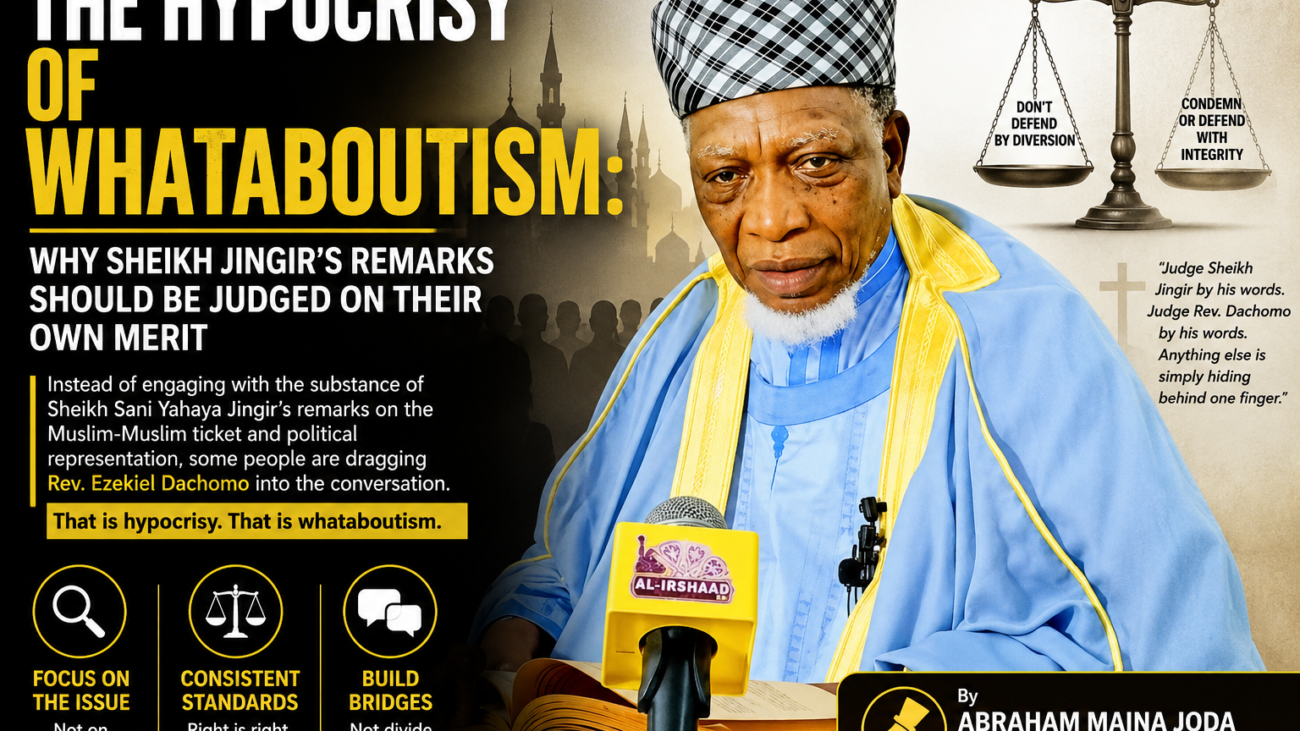
Judge Sheikh Jingir by Sheikh Jingir’s words. Judge Rev. Ezekiel Dachomo by Rev. Ezekiel Dachomo’s words.
Anything else is simply hiding behind one finger.
—
ABOUT THE AUTHOR
ABRAHAM MAINA JODA is a media professional, publisher and public affairs commentator. He is the Publisher of NewsNexus and the General Manager of SUM TV, with professional interests spanning journalism, media production, public policy, research and strategic communications.
Contact: 07038543606

Leave A Comment