

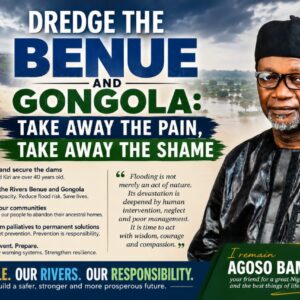
By Chief Agoso Huladeino Bamaiyi.
Flooding Must No Longer Be Treated as an Annual Act of God
The flood season is here again.
And, as has become painfully predictable, many of our people and communities living along the banks, floodplains and lower reaches of the Rivers Benue and Gongola are once again looking towards the skies and the rivers with apprehension.
For them, the rainy season is not simply a season of refreshing rains and agricultural promise. It can mean the loss of homes, farmlands, crops, livestock, businesses, schools, roads and livelihoods. It can mean displacement, disruption of communities and, tragically, the loss of human lives.
We cannot continue to accept this as though it were an unavoidable annual ritual.
For more than a decade, I have raised this matter because I believe that we are dealing with a problem that demands a permanent engineering, environmental and policy solution—not recurring emergency palliatives.
Palliatives have their place. When disaster strikes, government must provide relief to citizens who have lost their homes, possessions and livelihoods. But relief is not prevention. Food, mattresses, roofing sheets and temporary shelters distributed after a flood may alleviate immediate suffering, but they do not solve the problem that will bring the next flood.
A government that repeatedly treats the symptoms of a problem without confronting its causes is not solving the problem; it is merely managing its consequences.
That is why I appeal once again to the Federal Government, the Government of Adamawa State, the relevant River Basin Development Authorities, environmental and water-management agencies, and all other institutions responsible for the safety and development of our river systems: let us stop waiting for the next flood before we begin to act.
THIS IS NOT SIMPLY A NATURAL DISASTER
Let me be clear.
Flooding itself is a natural hydrological phenomenon. Rivers overflow their banks. Heavy rainfall occurs. Floodplains exist for ecological reasons.
But the scale, timing, intensity and human consequences of flooding are not determined by nature alone.
Human intervention has profoundly altered the hydrology of the Benue-Gongola system.
The construction of major dams—including Lagdo Dam upstream on the Benue in Cameroon and Kiri Dam on the Gongola in Nigeria—changed the way water is stored, released and transported through the river system. Kiri Dam was largely completed in 1982, while Lagdo was constructed between 1978 and 1982 according to World Bank documentation.
The World Bank’s assessment of the 2012 floods itself identified rising water levels and runoff in connection with several dams, including Lagdo and Kiri, among factors contributing to flooding downstream.
This does not mean that every flood downstream is caused by the dams. That would be an oversimplification.
It does mean, however, that once we have substantially altered a river system through dams, reservoirs, controlled releases, sedimentation and changes to river channels, we have a corresponding responsibility to manage the consequences intelligently.
And that responsibility belongs principally to government.
STOP TELLING EVERYBODY TO MOVE TO “HIGHER GROUND”
Every year, when the waters begin to rise, we hear the familiar advice:
“Move to higher ground.”
Of course, where lives are immediately threatened, people must move to safety. Human life must always come first.
But as a long-term public policy, simply telling communities to abandon their ancestral homes every rainy season is neither adequate nor acceptable.
Many of these communities did not suddenly appear on the banks of the Benue and Gongola yesterday.
They have lived beside these rivers for generations. Their settlements, farms, fishing grounds, markets, places of worship, burial grounds, cultural institutions and ancestral histories are intertwined with these waterways.
The river is not merely a geographical feature to them.
It is part of who they are.
Therefore, protecting these communities is not simply their responsibility. It is a responsibility of the State.
Where government changes the natural dynamics of a river through major infrastructure, government must also provide the infrastructure, regulation, early-warning systems, environmental management and protective measures necessary to safeguard the people living within the affected river basin.
THE REAL QUESTION IS: WHAT HAVE WE DONE TO MANAGE THE RIVERS?
We should stop approaching the Benue and Gongola primarily as enemies to be fled from.
They are among our greatest natural assets.
The Benue and Gongola support agriculture, fisheries, transportation, ecosystems, communities and countless livelihoods. Properly managed, they should be engines of economic development.
The question, therefore, should not merely be:
“How do we get people away from the river?”
The more intelligent question is:
“How do we manage the river so that people and the river can coexist safely and productively?”
That requires serious hydrological studies, continuous monitoring of river flows, proper reservoir management, floodplain management, early-warning systems, drainage and embankment infrastructure where appropriate, protection of vulnerable communities, environmental safeguards, and—where technically and environmentally justified—systematic dredging and restoration of critical river channels.
DREDGING CANNOT CONTINUE TO BE A TALKING POINT
For years, dredging the River Benue has been discussed.
For years, we have heard promises.
For years, floods have continued.
It is time to move from speeches and promises to engineering studies, budgets, procurement, implementation and measurable results.
I am not advocating indiscriminate excavation of rivers without proper environmental and hydrological assessment. Dredging must be scientifically designed. It must identify where sediment accumulation is actually restricting hydraulic capacity and determine the appropriate channel dimensions, disposal methods and environmental safeguards.
But where technical studies establish that sedimentation and reduced channel capacity are contributing materially to flood risk, government must act.
The same principle applies to the Gongola.
We need a comprehensive Benue-Gongola River Basin management strategy—not isolated interventions whenever a disaster occurs.
AND WHAT ABOUT THE DAMS?
There is another matter about which we must be courageous enough to speak.
Dam safety.
Kiri Dam was completed in 1982. It is therefore more than four decades old. Lagdo is similarly more than 40 years old.
Age alone does not make a dam unsafe. A properly designed and properly maintained dam can operate safely for many decades.
But age makes inspection, instrumentation, maintenance, rehabilitation and independent safety assessment increasingly important.
And this is no longer merely theoretical.
A peer-reviewed study published in 2026 on Lagdo Dam reported several signs of ageing and deterioration—including cracks, embankment degradation, erosion, water leakage and substantial sediment accumulation—and concluded that enhanced monitoring, rehabilitation, updated hazard analysis and emergency planning are necessary. The study also recommends periodic in-depth inspections and a formal emergency measures plan.
That should get our attention.
I am therefore not suggesting that Lagdo or Kiri dams are about to collapse. There is no responsible basis for making such a claim.
What I am saying is much simpler:
We must never wait for evidence of imminent failure before taking dam safety seriously.
The consequences of a major dam failure or uncontrolled release could be catastrophic. That possibility alone justifies rigorous preventive engineering.
LET US KNOW THE CONDITION OF THESE STRUCTURES
I therefore call for comprehensive, independent and up-to-date integrity and safety assessments of Kiri and all other ageing strategic dams within Nigeria’s river systems, and for Nigeria to engage the Cameroonian authorities regarding the continuing safety assessment and operation of Lagdo Dam.
Such assessments should include, among other things:
– structural and geotechnical integrity;
– spillway and outlet capacity;
– hydrological and extreme-flood analysis;
– sedimentation and loss of reservoir capacity;
– condition of gates, valves and other mechanical equipment;
– instrumentation and monitoring systems;
– downstream flood-risk modelling;
– dam-break and inundation modelling;
– emergency preparedness and warning systems; and
– rehabilitation, upgrading and long-term maintenance requirements.
We should know—not guess—the condition of these structures.
And where rehabilitation or upgrading is required, it should be undertaken before a crisis forces our hand.
LET US STOP WAITING FOR DISASTER
There is something fundamentally wrong with a governance system in which the sequence is always:
Flood → destruction → displacement → palliatives → promises → forgetfulness → another flood.
We must break that cycle.
The Nigerian people deserve better.
Our communities deserve better.
And the enormous economic value of the Benue and Gongola river systems deserves better.
I would therefore urge the Federal Government to establish a Benue-Gongola River Basin Flood and Water Management Programme involving the Federal Ministry of Water Resources and Sanitation, the relevant River Basin Development Authorities, NEMA, state governments, hydrologists, dam-safety engineers, environmental experts, affected communities and, where necessary, the Cameroonian authorities.
Its mandate should be practical and measurable:
Map the flood risks.
Assess the dams.
Monitor the reservoirs.
Study the sedimentation.
Dredge where science and engineering justify it.
Restore and maintain critical river channels.
Strengthen vulnerable communities.
Install effective early-warning systems.
Prepare credible emergency-response plans.
And, above all, prevent rather than repeatedly compensate for disaster.
THIS IS ABOUT MORE THAN FLOODS
This is about dignity.
It is about whether people should be allowed to live securely in the communities where their ancestors lived.
It is about whether farmers should plant their crops knowing that their harvests will not simply disappear beneath floodwaters.
It is about whether children should be able to attend school during the rainy season.
It is about whether communities should be permanently condemned to the cycle of displacement and relief.
And it is about whether government can demonstrate that it is capable of thinking beyond the next emergency and planning for the next generation.
The Benue and Gongola are not our enemies.
Poor management is the enemy.
Neglect is the enemy.
Short-term thinking is the enemy.
And the culture of waiting for disaster before taking preventive action is the enemy.
Let us therefore summon the political will, technical competence and financial commitment required to manage these magnificent rivers properly.
Dredge the Benue.
Dredge the Gongola—where technically and environmentally justified.
Secure the dams.
Protect the communities.
Strengthen the river system.
Break the annual cycle of destruction.
Take away the pain.
Take away the shame.
Our people have endured enough.
And I will continue to say this until somebody listens, until something is done, and until the annual flood season ceases to be an annual season of fear for our people.
I remain Agoso Bamaiyi, your friend for a great Nigeria and the best things of life.


Leave A Comment