

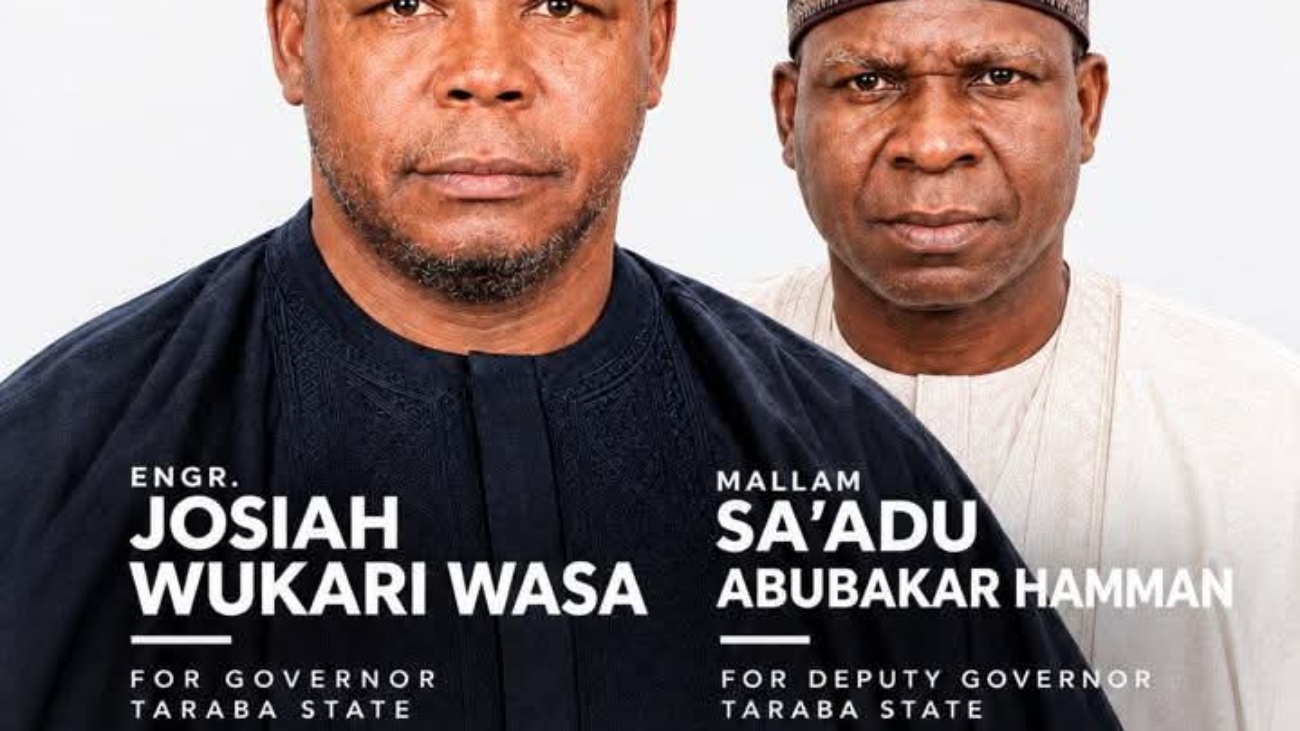
The PRP governorship candidate says Taraba’s transformation requires more than political leadership — it requires economic restructuring, stronger institutions, disciplined administration and deliberate investment in the state’s productive potential
By NEWSNEXUS Political Desk
As Taraba State moves towards another governorship election, the political conversation is gradually expanding beyond personalities, party structures and campaign slogans to a more fundamental question:
What kind of state should Taraba become over the next decade?
For Engr. Josiah Wukari Wasa, governorship candidate of the People’s Redemption Party (PRP), the answer begins with two interconnected challenges — how Taraba’s economy is structured and how the state is governed.
Wasa’s emerging manifesto is built around the argument that Taraba cannot sustainably develop while a large proportion of its citizens remain economically dependent on government or on people employed within government.
His proposed alternative is a deliberate economic policy designed to open up productive opportunities, create employment, expand the state’s revenue base, address housing pressures and gradually move Taraba from a predominantly rural economy towards an industrial or semi-industrial one.
But alongside economic transformation, Wasa argues that the state needs a different approach to administration.
In his view, governing a modern state requires more than political experience.
«“Running a government requires specific skills. It is not simply about somebody coming along and saying he is a politician.”»
For Wasa, those skills include managing organisations, people, expectations and productivity, while coordinating the various components of government towards measurable objectives.
It is this combination of economic restructuring and administrative reform that sits at the centre of his emerging political proposition.
THE ENGINEER AND THE POLITICAL ALTERNATIVE
Wasa is presenting himself not simply as another politician seeking the Government House but as an engineer and administrator bringing a technocratic approach to public policy.
His campaign describes him as an engineer and public servant whose professional experience has shaped a problem-solving approach to governance.
His political identity has also been associated with the phrase “Mr. Fixer”, reflecting his emphasis on identifying problems and developing practical interventions rather than relying exclusively on political rhetoric.
Wasa previously contested the Taraba governorship election as the PRP candidate in 2023. The Independent National Electoral Commission’s published candidate list confirms his participation under the PRP.
His present campaign therefore represents a continuation of an already established political project, but with an increasingly detailed emphasis on the economic and administrative architecture he believes Taraba requires.
—
THE ECONOMY FIRST
The most important element of Wasa’s emerging manifesto is his argument that Taraba needs a clear-cut economic policy capable of unlocking its productive potential.
He says such a policy should deliberately address unemployment, revenue generation, housing and private-sector development.
The underlying philosophy is straightforward: government must remain the primary engine and regulator of economic opportunity but without interfering in the normal operation of private enterprise. The government will also revive state firms and make them the engine of growth.
According to Wasa, the state must create conditions in which agriculture, manufacturing, mining, tourism, technology, construction, commerce and other productive sectors can generate employment and wealth.
“Everybody seems to depend on government or on someone working within government,” he observed.
For him, that situation is not a sustainable economic model.
The objective, therefore, is not simply to create more government jobs but to create an environment where people can create livelihoods outside government.
That distinction is central to his economic argument.
—
GOVERNMENT AS REGULATOR, NOT ABSENTEE
Wasa is equally careful about how he defines the role of government in his proposed economic system.
He says he is reluctant to describe the model simply as capitalism because he does not envisage government withdrawing and leaving private businesses to operate without restraint.
Instead, he proposes a system in which government actively regulates the private sector while creating conditions for investment and enterprise.
«“We will regulate their behaviour and ensure that the private sector operates within an appropriate framework.”»
The implication is a state that remains active in the economy, but whose role increasingly becomes that of regulator, facilitator, planner and coordinator rather than the dominant employer.
That approach raises an important policy question for Taraba: how can government encourage private investment while ensuring that economic expansion does not come at the expense of workers, communities or the environment?
Wasa’s answer is stronger regulation combined with deliberate economic planning.
—
FROM RURAL ECONOMY TO INDUSTRIAL TARABA
The long-term objective is ambitious.
Wasa wants Taraba to begin a transition from a predominantly rural economy towards an industrial or semi-industrial economy.
He recognises that such transformation may not be completed within a single administration.
But he argues that an administration should be judged partly by the structures it leaves behind.
«“If that transformation cannot happen completely within our time, then we must at least leave behind the legacy and structures that will allow it to continue.”»
That proposition places continuity at the centre of his development philosophy.
Rather than designing programmes around a four-year political cycle, the state would need long-term economic policies capable of surviving changes in government.
—
AGRICULTURE: FROM FARM PRODUCTION TO INDUSTRIAL VALUE
Agriculture occupies a major position in Wasa’s economic vision.
His campaign argues that Taraba’s agricultural advantage should be converted into an industrial opportunity through mechanisation, irrigation, improved rural roads, agricultural finance, storage, processing and stronger market access.
The objective is to reduce the practice of producing commodities in Taraba only for them to leave the state in raw form.
His proposed Taraba Integrated Agro-Industrial Park is envisioned as a major processing and export hub.
Under the proposal, crops such as cassava, soybean, tea, coffee and Irish potatoes would be processed within the state, alongside dairy and meat-processing facilities.
The larger economic principle is that Taraba should capture more of the value generated from its own resources.
Rather than simply asking how much farmers produce, the question becomes:
How much of the economic value generated by that production remains in Taraba?
Wasa’s campaign presents agro-processing as one answer.
—
TOURISM: TURNING NATURAL ASSETS INTO ECONOMIC ASSETS
Wasa’s economic vision also extends beyond agriculture.
He identifies Taraba’s mountains, rivers and waterfalls, forests, wildlife and cultural heritage as potential economic assets.
The Mambilla Plateau, Chappal Waddi and Gashaka-Gumti National Park feature prominently in his tourism proposition.
His campaign vision proposes the development of hospitality infrastructure, eco-tourism, adventure tourism, destination marketing and supporting infrastructure.
Among the targets contained in the campaign’s vision is the creation of tens of thousands of jobs and substantial tourism revenue.
Those figures are campaign projections rather than established outcomes, and their eventual feasibility would depend on investment, infrastructure, visitor numbers, security, hospitality capacity and the wider business environment.
But the underlying argument is clear:
Taraba’s natural beauty should be treated not only as something to admire, but as an economic resource capable of generating employment and investment.
—
MINERAL RESOURCES AND LOCAL VALUE CREATION
Mining is another component of the proposed economic diversification strategy.
Wasa identifies minerals including gold, columbite, tantalite, kaolin, limestone, gypsum and gemstones among the state’s potential resources.
His proposed approach involves formalising the sector, attracting responsible investors, encouraging local processing and ensuring that host communities participate in the benefits.
This is significant because the economic question is not simply whether Taraba possesses mineral resources.
The more important questions are:
Who controls the value chain?
Where does processing take place?
How many jobs are created locally?
How much revenue reaches government?
What benefits accrue to host communities?
Wasa’s position is that mineral exploitation should become part of a structured economic policy rather than remain predominantly an extraction activity.
—
ENERGY AS THE FOUNDATION OF INDUSTRIALISATION
No industrial strategy can succeed without energy.
Wasa therefore places electricity and energy infrastructure within his economic framework.
His campaign identifies Taraba’s rivers and existing energy projects as important components of the state’s potential.Wasa’s plan is to establish Rural electricity generating companies in the vicinity of our rivers. So that we have this projects as fallbacks whenever the national grid collapses.
The Mambilla Hydroelectric Project features prominently in his vision, alongside solar mini-grids and expanded electricity access. Although this will subject to the FG policy
Part of our vision is to explore the extension of yhe high tension national grid from Makurdi to Wukari to Bali to Jalingo. The immediate hanging fruits we will explore is to extend the national grid from Makurdi to Jalingo.
Further to our recent:
Taraba’s National Grid supply runs through one corridor currently: From Gombe to Yola to Mayo Belwa to Jalingo. Electricity access is thus limited to only the northern part of the State.
The vision is to add a second corridor from Makurdi to Wukari to Bali to Jalingo. Thus electricity to Central Taraba would be realised plus augmenting supply from Kashimbila to serve the southern district of the state.
His argument is that reliable electricity would have a multiplier effect:
Power attracts industry.
Industry attracts investment.
Investment creates jobs.
Jobs expand household incomes and government revenue.
The proposition is therefore that energy should be viewed not merely as a social service but as a core component of economic development.
—
INFRASTRUCTURE AS AN ECONOMIC TOOL
For Wasa, roads are not simply construction projects.
They are economic infrastructure.
A road connects farmers to markets, patients to hospitals, students to schools and businesses to customers.
That is why his campaign places emphasis on infrastructure across Taraba’s 16 local government areas.
The argument is that road construction should be prioritised according to economic and social impact, with stronger monitoring of project quality and delivery.
In this framework, infrastructure becomes part of economic planning rather than an isolated budget item.
—
THE HOUSING QUESTION
Housing also enters Wasa’s economic argument.
As the population grows and urban centres expand, the rising cost of housing increasingly becomes an economic issue rather than simply a construction problem.
A comprehensive housing policy, within the broader framework he is developing, would need to address land administration, infrastructure, financing, planning and private-sector participation.
His proposed digitisation of land administration is intended, among other things, to make the process more transparent and accessible.
The larger objective is to make housing development part of economic expansion rather than treating it only as a social intervention.
GOVERNMENT AS AN ORGANISATION
Perhaps the most distinctive part of Wasa’s political argument is his emphasis on administrative capacity.
He argues that government is the largest organisation in the state and therefore requires professional management.
A governor, in his conception, must understand how to manage people, institutions, resources and expectations.
Government departments must coordinate.
Targets must be established.
Performance must be measured.
Productivity must be monitored.
And public resources must produce identifiable outcomes.
This approach places institutional capacity at the centre of governance.
It also connects directly to another theme running through Wasa’s campaign: the belief that no individual can transform a state permanently without building institutions capable of continuing the work.
BUILDING INSTITUTIONS, NOT JUST PROJECTS
Wasa’s institutional argument is that leadership must survive beyond the individual occupying the Government House.
Strong institutions, according to this philosophy, create continuity.
They help protect policies from political disruption, strengthen public confidence, encourage investment and improve the delivery of services.
This is why his broader vision places emphasis on transparency, accountability, rule of law and public-sector performance.
The question is not merely:
What will the next governor build?
It is also:
What systems will the next governor establish that future administrations will be unable to easily dismantle?
HEALTHCARE CLOSE TO THE PEOPLE
Healthcare forms another pillar of the proposed agenda.
Wasa’s campaign advocates strengthening primary healthcare centres at the community and ward levels through improved staffing, essential medicines, maternal healthcare services, equipment and facilities.
The philosophy is that healthcare should begin close to where people live.
Instead of requiring citizens in rural communities to travel long distances for basic medical attention, primary healthcare facilities should provide functional first-line services.
YOUTH, JOBS AND THE DRUG QUESTION
Wasa also connects unemployment with wider social challenges, including drug abuse and insecurity.
His campaign’s “Jobs Over Drugs” message reflects the argument that substance abuse cannot be addressed only through law enforcement.
Young people need opportunities.
They need skills.
They need productive livelihoods.
They need access to entrepreneurship and vocational training.
The broader economic proposition is that a young population that has access to meaningful economic activity is better positioned to contribute productively to society.
DIGITAL TARABA
Technology occupies another part of the proposed transformation.
Wasa’s campaign advocates digital literacy, innovation hubs, broadband expansion, e-governance and technology-driven entrepreneurship.
His stated philosophy is captured in the phrase:
«“A connected Taraba is a competitive Taraba.”»
Digital government, in this conception, would not simply mean putting government services online.
It would also involve improving public financial management, increasing transparency, reducing administrative delays and limiting opportunities for financial leakages.
Part of the digital program will be to directly engage Telecommunications company to open up the rural areas.
—
FISCAL DISCIPLINE AND GOVERNMENT REVENUE
The economic transformation Wasa proposes ultimately raises the question of how government itself will finance development.
His analysis of Taraba’s public finances has led him to question the state’s dependence on federal allocations and borrowing.
His preferred direction is greater economic productivity, improved revenue administration and reduced financial leakages rather than simply increasing the burden on ordinary citizens.
The proposals include digital revenue collection, transparent procurement, stronger project monitoring and more responsible borrowing.
The philosophy is that government revenue should grow principally because the economy is growing.
THE FOUNDATION OF WASA’S SECURITY POLICY: BUILDING A SAFER TARABA TOGETHER
For Engr. Josiah Wukari Wasa, building a safer Taraba begins with a simple principle: security must be planned with the people, not merely delivered to them.
As a core component of the Wasa Blueprint, his proposed security policy places communities at the centre of security planning, recognising that lasting peace requires cooperation between the people, community leaders and formal security agencies.
Wasa’s approach rests on three key priorities: stronger collaboration with federal security agencies, effective intelligence gathering, and active community participation. By strengthening these relationships, communities can play a more meaningful role in identifying threats, reporting suspicious activities and preventing conflicts before they escalate.
His proposed approach also recognises that security goes beyond the presence of armed personnel. Better rural roads can improve access to vulnerable communities, while employment, vocational training and enterprise opportunities can help address some of the conditions that expose young people to criminal recruitment. Dialogue, fairness and respect for the law must also remain central to resolving disputes and maintaining peaceful coexistence.
The objective is straightforward: a Taraba where communities have a voice in their own security, security agencies are better informed, and citizens can live and work with greater confidence.
Through the Wasa Blueprint, Engr. Josiah Wukari Wasa proposes a security framework built on partnership, intelligence, justice and shared responsibility. Because a safer Taraba is not the responsibility of government alone. It is a common goal that government and the people must work together to achieve.
Building a Safer Taraba Together.
SOCIAL JUSTICE AND THE PRP PHILOSOPHY
Running through Wasa’s proposals is an emphasis on social justice.
His political platform is anchored in the People’s Redemption Party, whose historical identity is associated with the political philosophy of the late Mallam Aminu Kano.
Wasa’s campaign presents governance as an instrument for inclusion and argues that opportunities should not depend on geography, ethnicity, social status or political connections.
His broader message is that government exists to serve citizens rather than create privilege for a small political class.
TARABA’S UNTAPPED OPPORTUNITY
The different components of Wasa’s vision ultimately converge around one idea:
Taraba possesses resources, but resources alone do not create prosperity.
The state has agricultural land.
It has mineral resources.
It has rivers.
It has mountains.
It has forests and wildlife.
It has a youthful population.
It has cultural diversity.
But turning these assets into prosperity requires infrastructure, capital, institutions, skills, markets, regulation and deliberate government policy and direction.
That is the gap Wasa says his economic and administrative agenda is designed to address.
—
THE FIVE-YEAR QUESTION.
Wasa’s campaign vision proposes a roadmap based on measurable progress rather than open-ended promises.
Among the areas identified are improving the ease of doing business, digitising land administration, expanding energy access, supporting investors, strengthening infrastructure and promoting peace and stability.
The crucial test, however, would be implementation.
A manifesto can identify problems.
A government must establish priorities.
A government must finance them.
A government must execute them.
And, ultimately, citizens must be able to measure whether their lives have improved.
—
BEYOND THE 2027 ELECTION
Wasa’s political proposition is therefore larger than a list of projects.
At its heart is an argument about the structure of Taraba’s economy and the quality of its institutions.
He wants government to move from being predominantly an employer and distributor of resources to becoming a regulator, planner and catalyst for private economic activity.
He wants agriculture connected to processing.
Minerals connected to local value chains.
Tourism connected to infrastructure and investment.
Energy connected to industrialisation.
Technology connected to governance and employment.
And public administration connected to measurable performance.
Whether this approach can be translated into a workable programme of government will depend on the detailed policies, financing mechanisms, institutional arrangements and implementation plans that ultimately accompany the manifesto.
But the direction of his argument is unmistakable.
Wasa is asking Tarabans to consider a different development question.
Not simply who should govern Taraba?
But:
What economic structure should Taraba build?
What should government actually do?
How can the state’s natural resources become productive assets?
How can young people find meaningful employment outside government?
And how can institutions be built strong enough to continue development beyond one governor and one electoral cycle?
For the PRP candidate, those questions form the foundation of what he describes as a new direction for Taraba.
His vision is ultimately centred on moving the state from dependence to production, from potential to value, and from personality-driven governance towards stronger institutions.
As the 2027 political conversation develops, the electorate will have the opportunity to examine not only Wasa’s proposals, but also the assumptions, costs, timelines and implementation mechanisms behind them.
That may ultimately be one of the most important conversations Taraba can have before the next governorship election.

Leave A Comment