


By NewsNexus Research Desk
ABUJA — Who is actually performing in Nigeria’s 36 states?
Beyond political propaganda, commissioned projects, social-media campaigns and competing claims by governors and their supporters, the latest comprehensive national data provide a basis for comparing the performance of state governments.
The 2025 pcl. State Performance Index (pSPI) by Phillips Consulting remains the latest completed national comparative assessment. The 2026 pSPI was launched in July 2026, but its full state-by-state results are not yet publicly available. Phillips Consulting says the index evaluates states against their own potential and citizens’ lived experience, using multiple economic, governance, infrastructure and citizen-perception indicators.
The 2025 assessment therefore provides the most complete evidence currently available for comparing all 36 states.
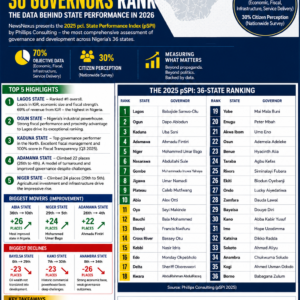
Importantly, the pSPI uses a revised methodology that places 70 per cent weight on objective data and 30 per cent on citizen perception. It incorporates audited financial information, economic indicators, infrastructure and public-service outcomes alongside a nationwide citizen survey.
THE 36-STATE RANKING
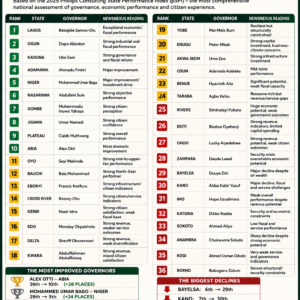
Rank| State| Governor| NewsNexus reading
1| Lagos| Babajide Sanwo-Olu| Exceptional economic/fiscal performance
2| Ogun| Dapo Abiodun| Strong industrial and fiscal performance
3| Kaduna| Uba Sani| Strong governance and fiscal reform
4| Adamawa| Ahmadu Fintiri| Major improvement
5| Niger| Mohammed Umar Bago| Major improvement/investment drive
6| Nasarawa| Abdullahi Sule| Strong objective performance
7| Gombe| Muhammadu Inuwa Yahaya| Strong citizen perception
8| Jigawa| Umar Namadi| Strong citizen confidence
9| Plateau| Caleb Mutfwang| Strong overall performance
10| Abia| Alex Otti| Most dramatic improvement
11| Oyo| Seyi Makinde| Strong mid-to-upper-tier performance
12| Bauchi| Bala Mohammed| Strong North-East performer
13| Ebonyi| Francis Nwifuru| Strong infrastructure/citizen indicators
14| Cross River| Bassey Otu| Strong citizen/service indicators
15| Kebbi| Nasir Idris| Strong citizen satisfaction, weak fiscal base
16| Edo| Monday Okpebholo| Strong revenue, weaker service outcomes
17| Delta| Sheriff Oborevwori| Strong revenue, weak diversification
18| Kwara| AbdulRahman AbdulRazaq| Strong revenue, mixed citizen satisfaction
19| Yobe| Mai Mala Buni| Resilient but structurally constrained
20| Enugu| Peter Mbah| Strong capital investment, business-climate concerns
21| Akwa Ibom| Umo Eno| Strong infrastructure investment
22| Osun| Ademola Adeleke| Mid-table performance
23| Benue| Hyacinth Alia| Significant potential, weak fiscal capacity
24| Taraba| Agbu Kefas| Resource-rich but revenue/service gaps
25| Rivers| Siminalayi Fubara| Huge economic potential, weak governance outcomes
26| Ekiti| Biodun Oyebanji| Strong revenue indicators, limited capital spending
27| Ondo| Lucky Aiyedatiwa| Strong revenue potential, weak citizen outcomes
28| Zamfara| Dauda Lawal| Security crisis overwhelms economic potential
29| Bayelsa| Douye Diri| Major decline despite oil wealth
30| Kano| Abba Kabir Yusuf| Major decline; fiscal and service challenges
31| Imo| Hope Uzodimma| Weak overall performance despite revenue potential
32| Katsina| Dikko Radda| Security and economic constraints
33| Sokoto| Ahmad Aliyu| Low fiscal and service performance
34| Anambra| Chukwuma Soludo| Sharp decline despite strong economic potential
35| Kogi| Ahmed Usman Ododo| Very weak service and governance indicators
36| Borno| Babagana Zulum| Severe structural/security constraints
The first ten positions are directly confirmed by the published 2025 pSPI reporting, while the complete state profiles and subsequent regional analyses provide the remaining positions
THE TOP FIVE: WHAT THE NUMBERS REALLY SAY
1. BABAJIDE SANWO-OLU — LAGOS
Lagos remains Nigeria’s strongest overall state performer.
The pSPI places Lagos first out of the 36 states, with a five-star rating. Its economic strength is unparalleled: IGR per capita, IGR per square kilometre and IGR per trade route all rank first nationally, while 69 per cent of total revenue comes from IGR.
This is arguably the strongest evidence of fiscal independence among Nigerian states.
But Lagos also demonstrates why economic size must not be confused with quality of governance.
The state’s debt per capita ranks last nationally in the pSPI dataset, while citizen satisfaction with several basic services remains disappointing. Phillips Consulting therefore describes Lagos as a state where enormous economic power has not translated proportionately into world-class public services.
NewsNexus verdict: Nigeria’s strongest economic and fiscal performer, but with a significant public-service and cost-of-living challenge.
2. DAPO ABIODUN — OGUN
Ogun occupies second place.
Its biggest advantage is its transformation into one of Nigeria’s most important industrial corridors.
The state benefits from its proximity to Lagos, extensive manufacturing activity, expanding logistics networks and a growing private-sector economy.
The pSPI gives Ogun an Exceptional 5-Star rating.
But there is a major qualification.
Economic performance has not translated proportionately into citizen satisfaction.
That makes Ogun one of Nigeria’s clearest examples of the difference between economic growth and inclusive development.
NewsNexus verdict: One of Nigeria’s strongest economic-development administrations, but public-service delivery must catch up with industrial growth
3. UBA SANI — KADUNA
Kaduna’s third position is particularly significant.
Unlike Lagos and Ogun, Kaduna operates in a much more difficult security environment.
Yet the state ranks third nationally.
Kaduna’s strengths include fiscal management, governance reforms and transparency. The state also performed strongly in independent fiscal-transparency assessments.
The Q3 2025 States Fiscal Transparency League Table, for example, placed Kaduna among the states scoring 100 per cent on the assessed transparency requirements.
NewsNexus verdict: The strongest overall northern governance performer in the pSPI, although security and citizen-service outcomes remain major challenges.
4. AHMADU FINTIRI — ADAMAWA
Adamawa may have the most impressive improvement story among the northern states.
The state moved from 26th to fourth.
That is a 22-place improvement.
The significance is that Adamawa does not have the economic advantages of Lagos or Ogun.
Its rise therefore suggests that improvements in governance can occur even where structural economic constraints are severe.
The state also achieved 100 per cent in the Q3 2025 fiscal-transparency league table.
NewsNexus verdict: One of Nigeria’s strongest examples of governance improvement relative to starting conditions.
5. MOHAMMED UMAR BAGO — NIGER
Niger State moved from 29th to fifth, representing a 24-place improvement.
Bago’s administration has pursued an ambitious agricultural and infrastructure agenda.
The state’s enormous landmass, agricultural resources and proximity to Abuja give it considerable economic potential.
The challenge is turning agricultural projects into productive value chains, processing industries, employment and sustainable internally generated revenue.
NewsNexus verdict: One of the country’s biggest turnaround stories, but the sustainability of the agricultural model will determine whether the improvement lasts.
THE MOST IMPROVED GOVERNORS
Three governors stand out dramatically when performance is measured by movement from the previous ranking:
🥇 Alex Otti — Abia
36th → 10th
+26 places
🥈 Mohammed Umar Bago — Niger
29th → 5th
+24 places
🥉 Ahmadu Fintiri — Adamawa
26th → 4th
+22 places
Phillips Consulting specifically identified these states among the biggest movers in the latest assessment.
This is arguably more revealing than simply looking at the top three.
A state that moves from 36th to 10th may demonstrate a greater rate of institutional improvement than a wealthy state that remains first because of structural advantages.
THE BIGGEST DECLINES
The opposite side of the ranking is equally important.
BAYELSA — 6th → 29th
Bayelsa recorded one of the most dramatic falls.
The state possesses enormous oil wealth, yet the pSPI indicates that its economic potential has not translated into commensurate governance outcomes.
KANO — 7th → 30th
Kano’s decline is particularly significant because it is one of Nigeria’s historic commercial centres.
A state with Kano’s population, trading networks and industrial history should theoretically be one of Nigeria’s leading economic performers.
Its position therefore represents a major warning about the consequences of weak fiscal and institutional performance.
ANAMBRA — 8th → 34th
Anambra is arguably the most striking contradiction.
It possesses Onitsha, Nnewi, a powerful entrepreneurial culture and a substantial commercial base.
Yet the pSPI places it 34th.
The assessment points to weaknesses in security, infrastructure investment and public-service delivery despite the state’s substantial economic potential.
WHAT ABOUT TARABA?
Taraba occupies 24th position.
This is an important result for a state with enormous natural-resource and agricultural potential.
The pSPI identifies Taraba’s strengths in:
– natural resources;
– agriculture and livestock;
– functional basic education infrastructure;
– economic opportunities.
But the weaknesses are substantial.
Taraba ranks 36th in IGR per square kilometre, 36th in IGR per trade route, and 31st in IGR as a share of total revenue. Only about 10 per cent of state revenue comes from IGR.
Citizen satisfaction is also weak in several areas.
Only 13 per cent of surveyed residents expressed satisfaction with road quality, while satisfaction with healthcare affordability was only 24 per cent.
At the same time, Taraba ranks first nationally in functional basic education facilities per population and fourth in affordability of public primary and secondary education.
This produces an interesting paradox:
«Taraba has enormous economic potential and some strong social indicators, but weak fiscal mobilisation and poor infrastructure prevent that potential from translating into a high overall ranking.»
NewsNexus verdict: Taraba is not a state without potential; it is a state where potential is significantly under-monetised.
THE SOUTH-SOUTH PARADOX
The South-South provides perhaps the clearest evidence that natural resources do not automatically produce good governance.
The 2025 ranking places:
– Cross River — 14th
– Edo — 16th
– Delta — 17th
– Akwa Ibom — 21st
– Rivers — 25th
– Bayelsa — 29th
Regional analysis of the pSPI describes the South-South as a zone with enormous wealth but inadequate conversion of resources into broad-based development.
This is particularly striking in Delta, Rivers and Bayelsa.
The region’s oil wealth should provide a significant fiscal advantage.
Yet the results demonstrate that revenue availability is not the same thing as governance effectiveness.
THE NORTH-WEST PROBLEM
The North-West’s ranking is equally revealing.
Only Kaduna and Jigawa make the national top 10.
The rest are:
– Kano — 30th
– Katsina — 32nd
– Sokoto — 33rd
– Kebbi — 15th
– Zamfara — 28th.
Jigawa is the region’s most interesting case because it ranks 8th nationally and first in citizen perception.
Kano, meanwhile, falls to 30th, despite its enormous population, commercial history and industrial potential.
This indicates a structural problem:
political importance has not translated into equivalent economic and institutional performance.
THE SOUTH-EAST CONTRADICTION
The South-East also produces a striking pattern:
State| Rank
Abia| 10th
Ebonyi| 13th
Enugu| 20th
Imo| 31st
Anambra| 34th
The region has some of Nigeria’s strongest entrepreneurial cultures, yet three of its five states rank outside the top 20.
Abia is the exception.
Its move from 36th to 10th is the largest positive movement in the national ranking.
WHAT THE 36-STATE DATA TEACH US
The ranking exposes five important realities about Nigerian governance.
1. MONEY MATTERS — BUT MONEY ALONE IS NOT ENOUGH
Lagos has extraordinary revenue capacity.
But its citizen satisfaction does not correspond proportionately to its wealth.
2. RESOURCE WEALTH CAN HIDE GOVERNANCE FAILURE
Bayelsa, Rivers and Delta demonstrate this problem.
Oil wealth does not automatically produce strong institutions.
3. SMALLER STATES CAN OUTPERFORM WEALTHIER STATES
Jigawa, Gombe, Nasarawa and Plateau show that states with smaller economic bases can perform strongly when resources are deployed more effectively.
4. TURNAROUND MATTERS
Abia, Adamawa and Niger demonstrate that measuring improvement over time can be as important as measuring absolute performance.
5. CITIZEN EXPERIENCE MATTERS
The pSPI’s 30 per cent citizen-perception component is important because a government should ultimately be judged by whether people experience improvements in their daily lives.
AN IMPORTANT METHODOLOGICAL WARNING
NewsNexus does not present the pSPI ranking as an infallible declaration of the “best” and “worst” governors.
Different indices measure different things.
For example, BudgIT’s 2025 State of States focuses primarily on fiscal sustainability, revenue generation, capital expenditure and debt. Its ranking is therefore substantially different from pSPI. BudgIT’s methodology specifically examines how states finance their budgets, grow internally generated revenue, invest in human capital and manage borrowing.
The 2025 BudgIT fiscal assessment places states differently from the pSPI, illustrating why one index should not be used as the sole basis for judging governance.
The pSPI itself says it is designed as a diagnostic and benchmarking tool, rather than merely a league table.
NEWSNEXUS FINAL ASSESSMENT
Based on the latest completed nationwide pSPI assessment, the governors can broadly be grouped as follows:
🟢 EXCEPTIONAL / NATIONAL LEADERS
Babajide Sanwo-Olu — Lagos
Dapo Abiodun — Ogun
🟢 STRONG NATIONAL PERFORMERS
Uba Sani — Kaduna
Ahmadu Fintiri — Adamawa
Mohammed Umar Bago — Niger
Abdullahi Sule — Nasarawa
🟢 STRONG / ABOVE-AVERAGE
Inuwa Yahaya — Gombe
Umar Namadi — Jigawa
Caleb Mutfwang — Plateau
Alex Otti — Abia
Seyi Makinde — Oyo
Bala Mohammed — Bauchi
Francis Nwifuru — Ebonyi
Bassey Otu — Cross River
Nasir Idris — Kebbi
🟡 MIXED PERFORMANCE
Monday Okpebholo — Edo
Sheriff Oborevwori — Delta
AbdulRahman AbdulRazaq — Kwara
Mai Mala Buni — Yobe
Peter Mbah — Enugu
Umo Eno — Akwa Ibom
Ademola Adeleke — Osun
Hyacinth Alia — Benue
Agbu Kefas — Taraba
Siminalayi Fubara — Rivers
Biodun Oyebanji — Ekiti
Lucky Aiyedatiwa — Ondo
🔴 UNDERPERFORMING / MAJOR REFORM REQUIRED
Dauda Lawal — Zamfara
Douye Diri — Bayelsa
Abba Kabir Yusuf — Kano
Hope Uzodimma — Imo
Dikko Radda — Katsina
Ahmad Aliyu — Sokoto
Chukwuma Soludo — Anambra
Ahmed Usman Ododo — Kogi
Babagana Zulum — Borno
This categorisation should be understood as a reading of the pSPI ranking, not an independent NewsNexus score.
THE NEWSNEXUS CONCLUSION
The most important lesson from Nigeria’s 36-state governance data is that the best governor is not necessarily the governor who spends the most money, commissions the most projects or controls the largest revenue base.
The stronger question is:
«How effectively does a governor convert the resources, opportunities and constraints inherited from his predecessor into measurable improvements in the lives of citizens?»
On that basis, Lagos, Ogun and Kaduna remain the national benchmark, while Adamawa, Niger and Abia deserve particular attention for the scale of their improvement.
But the data also expose serious contradictions.
A state can be rich and underperform.
A state can be poor and improve rapidly.
A state can have high citizen satisfaction but weak fiscal performance.
And a state can have strong audited numbers while citizens remain dissatisfied.
That is why the next generation of Nigerian governance assessment should move beyond “How many projects were commissioned?” to a more demanding question:
“How much measurable development did citizens receive for every naira available to government?”
That is the standard against which Nigeria’s governors should ultimately be judged.
Source base: Phillips Consulting 2025 State Performance Index; Phillips Consulting state-level pSPI profiles; BudgIT State of States 2025; States Fiscal Transparency League Table; NBS and other referenced public datasets. The 2026 pSPI has been launched but its complete national results are not yet publicly available, so the 2025 pSPI remains the latest completed 36-state comparative benchmark as of August 13, 2026.

Leave A Comment