


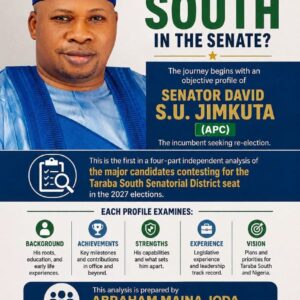
The journey begins with an objective profile of Senator David S.U. Jimkuta (APC), the incumbent seeking re-election.
This is the first in a four-part independent analysis of the major candidates contesting for the Taraba South Senatorial District seat in the 2027 elections. Each profile examines the candidate’s background, achievements, strengths, experience, and vision to help voters make informed decisions.
This analysis is prepared by Abraham Maina Joda and his team of political analysts and political scientists.
Read. Analyse. Engage. Share your views respectfully.
Senator David S.U. Jimkuta: The Grassroots Incumbent Seeking a Second Mandate
Senator David S.U. Jimkuta enters the 2027 race for the Taraba South Senatorial District as the incumbent senator and arguably one of the most formidable political figures in the district. Representing Taraba South in the 10th National Assembly under the All Progressives Congress (APC), Jimkuta has built a political identity rooted in grassroots mobilization, resilience, constituency engagement, and a remarkable personal story of rising from humble beginnings to one of the most influential political offices in the state.
His political journey is often cited by supporters as one of determination and perseverance. Jimkuta has publicly spoken about his modest upbringing, including a period in his life when he worked as a commercial motorcycle rider, popularly known as an okada rider. Before his election to the Senate, he reportedly served in various political capacities, including as a legislative aide, political administrator, youth mobilizer, and grassroots organizer within the APC. These experiences helped him develop an extensive political network and a deep understanding of the everyday concerns of ordinary citizens.
His emergence on the national political stage came in dramatic fashion during the 2023 general elections. After winning the APC senatorial primary, Jimkuta became involved in a prolonged legal battle over the party’s ticket. The dispute traversed the Federal High Court, Court of Appeal, and ultimately the Supreme Court, which affirmed him as the rightful APC candidate for Taraba South.
Armed with that victory, he went on to record what many political observers regard as one of the biggest electoral upsets in Taraba State’s recent history. Contesting against then-Governor Darius Dickson Ishaku, who was widely considered the favourite, Jimkuta secured more than 85,000 votes to win the Senate seat. The victory not only elevated his political profile nationally but also established him as a leading figure within the APC in Taraba State.
Since assuming office, Senator Jimkuta has sought to build a reputation as a constituency-focused legislator. Within the Senate, he has served as Chairman of the Senate Committee on FCT Area Councils and Ancillary Matters and also chaired the Senate Committee on Social Welfare and Poverty Alleviation. His legislative activities have included sponsorship and promotion of bills aimed at expanding educational and economic opportunities in Taraba State and beyond.
Among the notable legislative initiatives associated with him are the Nigeria Tea Development Authority Bill, the bill seeking the establishment of a Federal University in Wukari, and the proposed Federal College of Fisheries and Aquaculture in Ibi. Supporters argue that these initiatives reflect an effort to leverage federal institutions and investments for the benefit of Taraba South.
However, it is in constituency development and empowerment programmes that Senator Jimkuta has perhaps made his strongest political impact. Across the five local government areas of Taraba South—Wukari, Ibi, Takum, Ussa, and Donga—his office has been associated with numerous empowerment and development initiatives.
His economic empowerment programmes have reportedly included the distribution of vehicles, motorcycles, tricycles, sewing machines, grinding machines, irrigation pumps, and agricultural equipment to constituents. He has also sponsored skills acquisition programmes and self-employment initiatives targeted at youths, women, artisans, and small business owners through his STEP empowerment programme.
In education, his interventions have included sponsorship of JAMB registrations, payment of school fees, scholarship awards, and an international scholarship programme that reportedly facilitated educational opportunities for dozens of youths in India.
Infrastructure-related interventions credited to him include advocacy for the reconstruction of the Wukari-Akwana Road, rural electrification projects, solar-powered street lighting installations, and the renovation and digitization of the Wukari Library. His supporters point to these projects as evidence of a senator focused on delivering tangible benefits to his constituents.
In the area of social welfare and poverty reduction, he has sponsored programmes for farmers, traders, vulnerable persons, and rural communities through the distribution of agricultural inputs, equipment, and various empowerment packages.
Politically, Senator Jimkuta enjoys the advantage of incumbency, a factor that many analysts believe will make him one of the most difficult candidates to defeat in the upcoming election. Having spent nearly four years in office, he has had the opportunity to build political structures, deepen grassroots relationships, and establish a visible record of constituency interventions.
While some observers note that he may not possess the extensive academic credentials, international exposure, or technocratic profile associated with some of his opponents, supporters argue that he more than compensates for this with strong native intelligence, political instinct, and an exceptional ability to connect with ordinary people. His grassroots appeal is widely regarded as one of his greatest political strengths.
Many of his supporters also describe him as a practical politician who understands the needs of rural communities because he has personally experienced many of the challenges faced by ordinary citizens. This relatability has enabled him to cultivate a loyal support base across different communities in the senatorial district.
Among APC supporters and many political observers in Taraba State, Jimkuta is often cited as one of the most visible and active members of the state’s National Assembly delegation. Some analysts have even argued that, based on the scale of his constituency empowerment programmes and grassroots engagement, he has distinguished himself as one of the most impactful senators currently representing Taraba State.
Another factor likely to strengthen his re-election prospects is the growing influence of the APC in Taraba State. Following the political realignments that brought the state’s executive leadership into the APC fold, the party now controls significant political structures and governmental machinery. As the incumbent APC senator for Taraba South, Jimkuta is expected to benefit from these advantages while also relying on the personal goodwill he has cultivated among constituents.
As the 2027 election approaches, Senator David S.U. Jimkuta enters the contest with a compelling combination of incumbency, grassroots appeal, political resilience, and a substantial record of constituency interventions. His supporters argue that he has hit the ground running since arriving in the Senate, positively affecting lives through empowerment, education, infrastructure, and social welfare programmes. Whether these achievements will be sufficient to secure a second term remains to be seen, but few observers doubt that he will be one of the strongest and most difficult candidates in the race for the Taraba South Senatorial seat.

Leave A Comment