


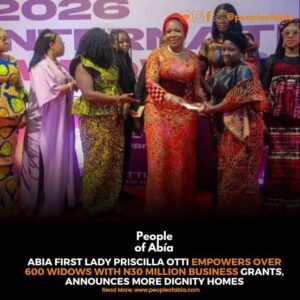
The wife of the Abia State Governor, Mrs. Priscilla Otti, has provided business grants of ₦50,000 each to more than 600 widows across the state as part of activities marking the 2026 International Widows’ Day.
The empowerment programme, held at the JAAC Secretariat in Umuahia, was organised around the theme: “Justice, Dignity and Economic Power for Widows.”
The initiative is aimed at helping beneficiaries establish or strengthen small businesses and improve their economic independence.
Speaking at the event, Mrs. Otti described justice for widows as a moral responsibility, stressing that economic empowerment remains critical to enabling widows to become self-reliant rather than dependent on charity.
BEYOND CASH SUPPORT
The grant programme forms part of a broader intervention being promoted through the office of the governor’s wife, including the Dignity Homes Initiative.
Under the initiative, 35 indigent widows—one from each of the state’s 17 local government areas—have reportedly received completed homes and livelihood support, while plans are underway to provide an additional 17 homes.
The approach represents an attempt to combine immediate economic assistance with longer-term interventions around housing and livelihood.
GOVERNMENT PRIORITISES WIDOWS’ WELFARE
The Commissioner for Poverty Alleviation and Social Protection, Mrs. Ngozi Blessing Felix, said the administration of Governor Alex Otti had made the welfare of widows part of its broader social protection agenda.
According to her, government interventions include healthcare, livelihood support and measures aimed at protecting widows’ property rights.
She also called for greater cooperation among government institutions, traditional authorities, communities and civil society organisations to address harmful widowhood practices.
NEWSNEXUS ANALYSIS: FROM CHARITY TO ECONOMIC EMPOWERMENT
The significance of the Abia initiative extends beyond the ₦50,000 distributed to individual beneficiaries.
For many vulnerable households, small capital injections can provide an opportunity to restart petty trading, food processing, farming, handicrafts or other micro-enterprises. However, the long-term impact of such programmes will depend on whether beneficiaries receive follow-up support, business training, access to markets and opportunities to expand their enterprises.
The housing component is equally significant because economic vulnerability among widows can be compounded by insecurity of shelter and disputes over property or inheritance.
The bigger policy question, therefore, is whether interventions of this nature can evolve from one-off empowerment programmes into sustainable social-protection systems.
For Abia State, the combination of cash assistance, housing, livelihood support and property-rights protection could provide a more comprehensive framework for addressing the vulnerabilities faced by widows.
The real measure of success, however, will ultimately be found in what happens after the grants are distributed: whether beneficiaries are able to establish sustainable businesses, improve household incomes and achieve greater economic independence.
NewsNexus Media will continue to track such interventions not only from the perspective of announcements and beneficiaries, but also by examining their implementation, reach and measurable impact on vulnerable communities.

Leave A Comment