

By Grey Wren
As the countdown to Nigeria’s 2027 general elections quietly begins, the battle for Taraba Government House is already taking shape not through official campaigns, but through consultations, political realignments, grassroots mobilisation, and strategic positioning.
Although the Independent National Electoral Commission (INEC) has not opened the official campaign window, political conversations across Taraba have shifted toward one question Who has the strength, the strategy, and the resources to emerge victorious?
In modern politics, elections are rarely decided by popularity alone. They are shaped by a combination of financial capacity, political structures, party unity, grassroots appeal, public perception, and the ability to sustain a statewide campaign.
This analysis examines the current political landscape in Taraba State. It does not attempt to establish who is financing any campaign or allege wrongdoing by any individual. Rather, it assesses the relative strengths and challenges of some of the leading figures whose names are already featuring prominently in discussions about the 2027 governorship race.
Why Money Matters But Is Not Everything
Running a governorship campaign in a geographically diverse state such as Taraba requires substantial resources. Aspirants need campaign offices, transportation, communication teams, volunteers, media visibility, logistics, and the ability to engage communities across the state’s sixteen local government areas.
Yet history has shown that money alone does not guarantee victory. Voters also weigh performance, credibility, party cohesion, local acceptance, and the political mood of the electorate. The 2027 contest is therefore expected to be shaped by a combination of financial resources and political strategy.
Governor Agbu Kefas: The Power of Incumbency
Governor Agbu Kefas enters the conversation from a position no other aspirant currently enjoys the advantages associated with incumbency.
An incumbent governor naturally commands greater public visibility through official engagements and government activities. He also benefits from an established statewide political network built around elected officials, commissioners, advisers, party leaders, and supporters.
Political observers generally regard incumbency as a significant electoral advantage because it provides organisational capacity and greater name recognition.
Supporters of the governor argue that his administration’s performance and political alliances could strengthen his prospects if he seeks another term. Critics, however, contend that the final verdict will depend on how voters assess his record in office rather than the advantages of incumbency alone.
Recently, a governorship aspirant alleged in a widely circulated online video that government contracts were being awarded mainly to friends and associates from the Niger Delta instead of indigenous contractors. Taraba News has not independently verified this allegation, and it is presented here solely as a political claim made during the emerging contest. At the time of writing, no official response from the state government had been incorporated into this analysis.
Ultimately, the governor’s greatest strength may lie in his existing political network and institutional visibility, while his greatest challenge will be convincing voters that his first term deserves renewal.
Senator Emmanuel Bwacha: Experience Meets Internal Party Challenges
Former Senator Emmanuel Bwacha remains one of the most recognisable political figures in Taraba State.
Having contested the governorship in 2023, he already possesses statewide visibility and a network of supporters. His recent call to the Nigerian Bar has also enhanced his public profile.
Many observers believe his decision in the previous election cycle to identify with younger political voices strengthened his appeal among sections of the youth.
His campaign message is expected to draw comparisons between his vision for the state and the performance of the incumbent administration.
However, his political calculations are complicated by divisions within the People’s Democratic Party (PDP). Internal disagreements and competing leadership tendencies could affect the party’s ability to present a united front if they remain unresolved.
Another strategic consideration is that both Bwacha and Governor Kefas have political roots in the same senatorial zone, making regional voting dynamics an issue that political analysts will continue to watch.
Senator Joel Ikenya: Banking on Experience
Former Senator Joel Ikenya brings one of the most extensive public service records among the possible contenders.
His career has included service as a member of the Taraba State House of Assembly, a member of the House of Representatives, a Senator of the Federal Republic, and Minister of Labour and Productivity.
This breadth of experience gives him credibility among voters who value institutional knowledge and long-standing political relationships.
His supporters argue that his understanding of both state and federal governance positions him to provide experienced leadership.
Nevertheless, like other figures associated with the PDP, his political trajectory may depend partly on how the party’s internal disputes are resolved. Questions also remain about the strength and cohesion of his current political structure compared with those of his rivals.
Professor Jerome Nyameh: Grassroots Politics Without Deep Pockets?
Professor Jerome Nyameh represents a different political proposition.
Known in many communities as an educator, entrepreneur, and community development advocate, he has built much of his public image around direct engagement with ordinary citizens.
Supporters frequently describe him as “the People’s Professor,” pointing to his interactions with young people, market women, community groups, and rural communities.
Unlike aspirants who rely primarily on long-established political structures, Professor Nyameh’s influence appears to stem from sustained grassroots engagement and his reputation within local communities.
His challenge, however, may be translating grassroots goodwill into a statewide electoral machine capable of competing with larger, more established political organisations. Limited financial resources and lower institutional influence could make statewide mobilisation more demanding.
Comparing the Field
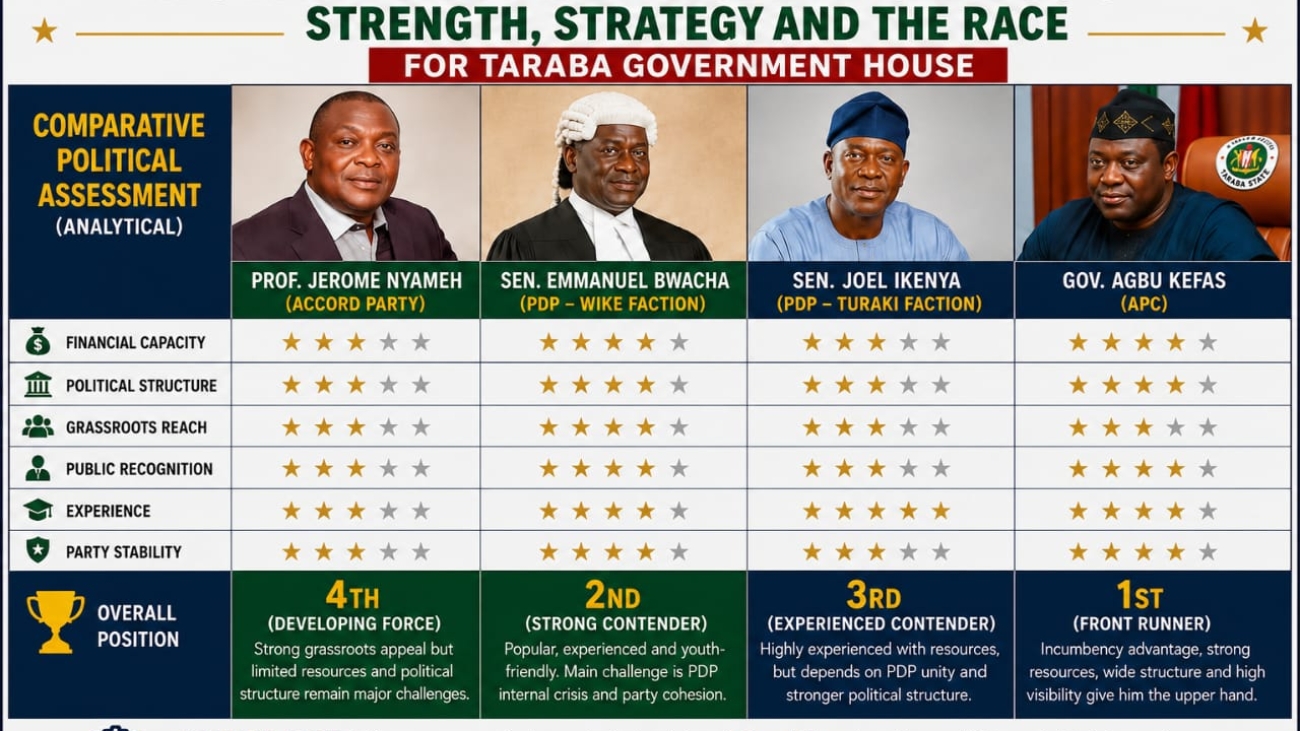
The following assessments are analytical opinions based on publicly known political factors and the current political environment. They are not measurements of fact or predictions of election outcomes.
Category| Governor Agbu Kefas| Sen. Emmanuel Bwacha| Sen. Joel Ikenya| Prof. Jerome Nyameh
Financial Capacity| Very Strong| Strong| Strong| Moderate
Incumbency Advantage| Very Strong| None| None| None
Political Structure| Very Strong| Strong| Moderate| Developing
Grassroots Reach| Strong| Strong| Moderate| Very Strong
Public Recognition| Very Strong| Very Strong| Strong| Strong
Party Stability| Strong| Uncertain| Uncertain| Moderate
Administrative Experience| Very Strong| Strong| Very Strong| Moderate
The Real Currency of 2027
While financial resources remain important, they are unlikely to be the only deciding factor.
The incumbent may enjoy advantages in visibility and organisation, but challengers could benefit if voters seek change or if they succeed in building broad coalitions.
Similarly, aspirants with fewer financial resources may compensate through volunteer mobilisation, community engagement, persuasive messaging, and effective political alliances.
In Taraba’s political history, personal relationships, ethnic balance, local alliances, party unity, and voter turnout have often influenced election outcomes alongside campaign spending.
What Should Voters Watch?
As political activities intensify, voters should pay close attention to The policy ideas each aspirant presents, The quality of their political teams, Their plans for education, healthcare, infrastructure, agriculture, and youth employment, The unity and discipline of their political parties, Their ability to connect with communities across Taraba.
Beyond campaign promises, transparency, accountability, and issue-based debates will remain essential indicators of leadership.
Based on the current political landscape, Governor Agbu Kefas appears to begin the race with the strongest structural advantages because of incumbency, statewide visibility, and an established political network.
Among the challengers, Senator Emmanuel Bwacha and Senator Joel Ikenya possess extensive political experience and name recognition, but the effectiveness of their ambitions may depend significantly on the direction of the PDP and its internal cohesion.
Professor Jerome Nyameh enters the conversation from a different angle, drawing strength from grassroots engagement and community acceptance. If he can broaden his political structure and sustain statewide mobilisation, he could shape the dynamics of the contest even in the face of better-resourced opponents.
At this stage, however, it would be premature to declare any candidate the clear favourite. Political alliances can change, party dynamics can evolve, new entrants may emerge, and ultimately it is the electorate—not financial resources alone—that will determine who occupies Taraba Government House after the 2027 election.
For now, one conclusion stands out, the road to 2027 has begun, and the contest will be defined not only by money, but by organisation, strategy, credibility, and the confidence of the people of Taraba.

Leave A Comment