


 By: Rikwen R. Jonathan
There is an African proverb that says, “A child who washes his hands well eats with elders.” I have always understood that proverb to mean that before asking for a place at the table, you should show that you are prepared for the responsibility that comes with sitting there. That is how I have come to look at Abubakar Barde, not simply because of the political ambition he has brought back to the table, but because of the journey that has brought him here.
In Nigerian politics, it is easy to remain visible when there is something to be won. The harder test is remaining present when there is nothing immediately to gain. That is why, when I look at Barde’s political journey, I am less interested in the campaign around 2027 than in what happened between elections. His story, to me, is fundamentally about staying connected.
Barde’s political journey did not begin with 2027, or even with his attempt to enter the House of Representatives. He had spent years involved in political and grassroots mobilisation while building a professional life in Abuja, including working within the political environment around former Minister Solomon Dalung and serving as Deputy National Coordinator of the Buhari New Media Centre. That experience eventually took him into the 2022 APC primary for the Donga, Takum, Ussa and Yangtu federal constituency, where he defeated four other aspirants with 28,002 votes out of 47,899 votes cast across the 32 wards. The result was announced and certified by the returning officer.
But the journey did not end with that primary victory. Despite winning the direct primary, Barde did not eventually go into the 2023 general election as the APC candidate for the constituency. The political circumstances that followed meant that Mark Bako Useni eventually emerged as the APC candidate and went on to win the seat in the supplementary election. Barde took the setback in good faith, holding firmly to his belief that political power ultimately comes from God.
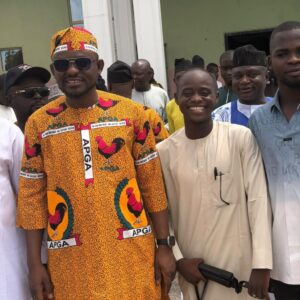
His political journey has since taken a different direction. As he prepares for another attempt at representing the constituency in 2027, Barde is now on the platform of the All Progressives Grand Alliance, APGA. His emergence under a different political platform is part of the new political reality surrounding the 2027 contest, but for me, the more interesting question is what remained unchanged through that transition: his connection with the people remained constant.
That presence is something I have personally witnessed. Barde may live and work in the Federal Capital Territory, but he has continued to move around his constituency, meeting people, attending community events, visiting families and responding to people who need his attention. I have seen the ease with which he relates with ordinary people. He is accessible, cheerful and comfortable among the people, and that matters in a political environment where some politicians become increasingly distant once an election is over.
His interventions have also gone beyond political office. I have seen him support people living with disabilities, assist women through empowerment initiatives, respond to families in need and contribute to basic community needs, including water. I would not describe these individual interventions as a substitute for the broader development responsibilities of government. They are not. But they tell us something about a politician’s relationship with the people and, more importantly, whether that relationship survives outside an election cycle.
There is another part of this journey that deserves attention. Long before the 2027 election becomes a matter of posters, rallies and campaign promises, political participation begins with something much more basic: getting citizens registered and prepared to participate. Barde was already mobilising around the INEC Continuous Voter Registration process, encouraging people to take the first practical step toward exercising their democratic rights. That is the kind of groundwork that can easily be ignored because it does not come with the excitement of an election day, but it is part of what serious political organisation requires.
This is why I see Barde’s return to the political conversation differently from the usual cycle of Nigerian politics. His story is not simply about a politician who contested, lost an opportunity and returned. It is about what happened in the space between those moments. The real test was whether the relationships built before the election would survive after the election. In Barde’s case, they did.
There is also something instructive about the fact that he has built much of his professional and political life away from the constituency. Abuja has been part of his working life for years, yet distance has not translated into political absence. He has continued to come home, stay in touch and maintain relationships with the people. That balance is not insignificant. Representation is not only about where a politician lives; it is also about whether the people he seeks to represent can reach him and whether he understands the realities they live with.
As 2027 approaches, that history will inevitably become part of the conversation in Donga, Takum, Ussa and Yangtu. There will be other aspirants, other parties, other arguments and other promises. That is how democracy should work. But candidates should also be considered within the full context of their political journey, not simply by what they say when another election is approaching.
For me, the most interesting part of Barde’s story is therefore not that he is returning to the race. It is that he never completely left the people behind. The setback of 2023 did not end his engagement with the constituency. If anything, the years since then have provided a different measure of his political character: what does a politician do when the office he sought is no longer within reach? Barde stayed connected.
And now, as the road to 2027 becomes clearer, the people of Donga, Takum, Ussa and Yangtu will have the opportunity to look at the entire journey, from the years of grassroots mobilisation, through the 2022 primary and the events that followed, to the years of continued presence in the communities and now his new political chapter under APGA.
Political choices are ultimately about the kind of representation people want and the record they believe deserves their confidence. In that conversation, Barde’s record should be considered in full, not only from the point of view of what he hopes to do tomorrow, but also from what he has continued to do when there was no office to occupy.

Leave A Comment