

By NewsNexus Research Desk
Borrowing has become one of the defining issues in public discourse surrounding the administration of Governor Agbu Kefas since he assumed office on 29 May 2023. Supporters argue that access to long-term financing is necessary to bridge Taraba State’s infrastructure deficit and stimulate economic growth. Critics, on the other hand, have questioned the scale of the borrowing plans, with some claiming that the state has accumulated debts of as much as ₦800 billion.
The issue has generated widespread public interest, but it has also been accompanied by figures that are often presented without distinction between approved borrowing, financing agreements and officially recorded debt. This report examines the available evidence from the Debt Management Office (DMO), legislative approvals, and official government announcements to provide a clearer understanding of Taraba State’s borrowing profile.
The Importance of Distinguishing Between Borrowing Terms
Government financing involves several stages, each with a different legal and financial implication.
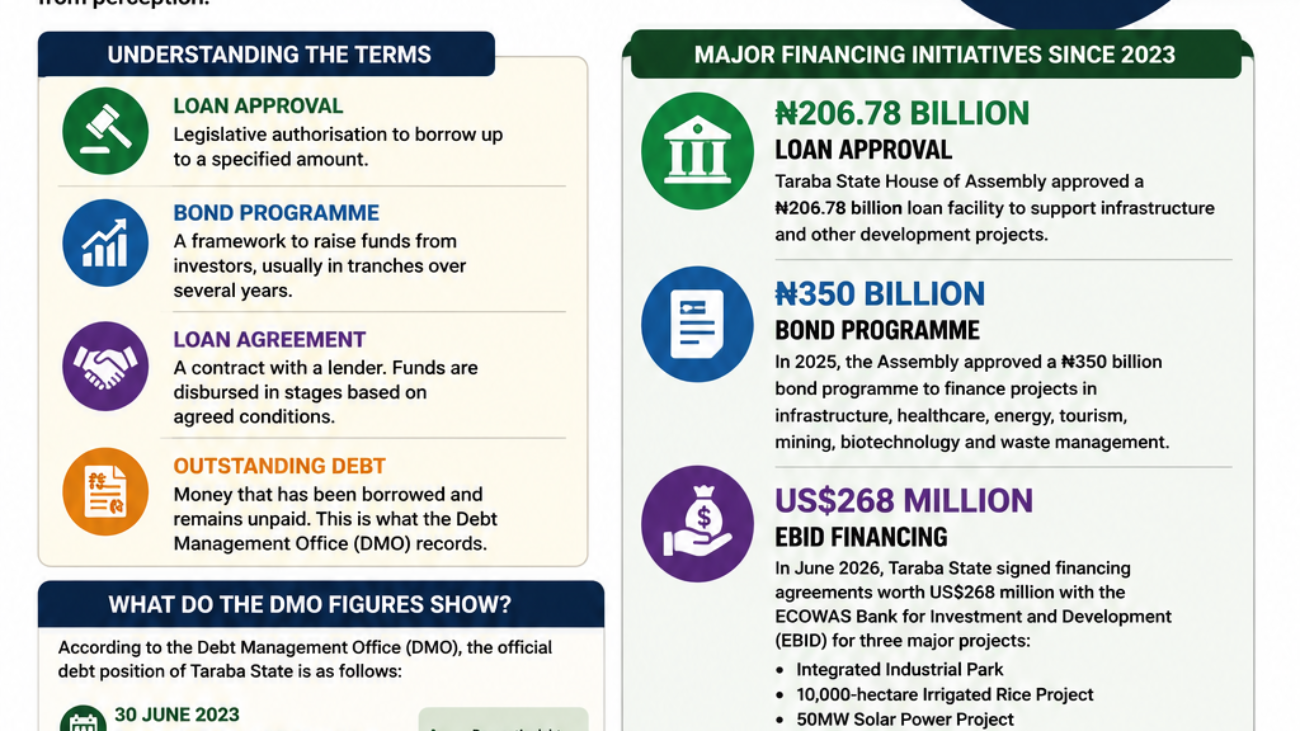
A loan approval is legislative authorization allowing a government to borrow up to a specified amount. A bond programme authorizes the government to raise funds from investors, usually over several years and often in multiple tranches rather than all at once. A loan agreement is a contract signed with a lender, but funds are commonly released in phases after agreed conditions have been met. Outstanding debt, on the other hand, refers only to money that has actually been borrowed and remains unpaid.
Understanding these distinctions is essential because the value of approved financing is not necessarily the same as the amount that has been borrowed or recorded as debt.
The Debt Profile Governor Kefas Inherited
Governor Agbu Kefas assumed office at a time when Taraba State already had significant financial obligations.
According to the Debt Management Office (DMO), as of 30 June 2023, Taraba State had an outstanding domestic debt of ₦87.96 billion and an external debt of US$46.47 million. These figures represent the official debt stock recorded shortly after the commencement of the current administration and provide the baseline against which subsequent developments can be assessed.
What Has Changed Since Then?
The DMO’s subsequent publications show that Taraba’s debt profile has changed over time.
By 31 December 2024, the state’s officially recorded domestic debt had declined to ₦81.39 billion, while the external debt remained around US$46 million, reflecting only marginal movement.
The latest DMO report, covering 31 December 2025, shows that Taraba’s domestic debt stood at ₦85.51 billion. The external debt remained broadly at the same level, with changes largely reflecting repayments and exchange-rate adjustments rather than major shifts in borrowing.
These figures indicate that while the state’s domestic debt increased between the end of 2024 and the end of 2025, it remained close to the level recorded when the current administration came into office.
Major Financing Initiatives of the Current Administration
Since 2023, the Taraba State Government has pursued several major financing initiatives to support its development agenda.
One of the earliest was the approval by the Taraba State House of Assembly of a ₦206.78 billion loan facility. The government indicated that the financing would support infrastructure and other strategic development projects across the state.
In 2025, the House of Assembly also approved a ₦350 billion bond programme. According to official explanations, the programme was designed to finance long-term investments in road infrastructure, healthcare, biotechnology, tourism, mining, energy and waste management. As with most capital market programmes, the approval authorizes borrowing over time and does not necessarily mean that the full amount is raised immediately.
The administration also secured international development financing. In June 2026, Taraba State signed financing agreements worth US$268 million with the ECOWAS Bank for Investment and Development (EBID). According to the state government, the financing is intended for three major projects: an integrated industrial park, a 10,000-hectare irrigated rice production scheme with processing facilities, and a 50-megawatt solar power plant for Jalingo and surrounding communities.
Development finance institutions such as EBID typically release funds in stages based on project implementation milestones and agreed financing conditions.
Where Does the ₦800 Billion Figure Come From?
The claim that Taraba has borrowed ₦800 billion appears to stem from combining several different financing initiatives.
The figures frequently cited include the ₦206.78 billion loan approval, the ₦350 billion bond programme, and the US$268 million EBID financing, converted into naira using prevailing exchange rates.
Depending on the exchange rate applied, the combined value of these approvals and financing agreements can exceed ₦800 billion.
However, financial experts generally distinguish between approved financing, signed financing agreements, and outstanding debt. Combining all approved facilities into a single figure does not, by itself, establish that the entire amount has been borrowed, received or disbursed.
What Do the Official Debt Records Show?
The Debt Management Office is Nigeria’s statutory authority responsible for maintaining records of public debt. Its reports reflect debt that has been incurred and remains outstanding.
The latest DMO publication, covering 31 December 2025, records Taraba State’s domestic debt at ₦85.51 billion, with the state also maintaining outstanding external obligations.
The official figures therefore differ significantly from the larger amounts sometimes cited in public debate because the DMO reports actual outstanding debt rather than the cumulative value of borrowing approvals or financing commitments.
Why Borrowing Should Be Viewed in Context
Borrowing is a common financing instrument used by governments worldwide to fund infrastructure and long-term capital projects that may not be immediately affordable through annual budgets.
The sustainability of public borrowing depends on several factors, including the amount eventually drawn, repayment terms, project execution, the economic returns generated by the investments, and the government’s ability to service its obligations without placing undue pressure on future public finances.
Consequently, assessments of government borrowing are generally more meaningful when they consider not only the value of financing approvals but also the extent of actual disbursement, project implementation and measurable outcomes.
Conclusion
The available evidence confirms that the Taraba State Government has pursued significant financing initiatives since 2023, including legislative approvals for major borrowing, a bond programme and international development financing.
Official data published by the Debt Management Office shows that Taraba State’s recorded domestic debt stood at ₦85.51 billion as of 31 December 2025, compared with ₦87.96 billion shortly after the current administration assumed office. The state’s external debt has remained at approximately US$46 million, according to DMO records.
While the combined value of borrowing approvals and financing agreements announced by the government can exceed ₦800 billion, publicly available official debt records do not, by themselves, establish that this amount has already been borrowed or is reflected in the state’s outstanding debt profile.
As more recent DMO reports, audited financial statements and project implementation updates become available, they will provide a clearer picture of the extent to which approved financing has been accessed, utilised and reflected in Taraba State’s official debt position.
Sources: Debt Management Office (DMO) reports on States’ Domestic Debt Stock and External Debt Stock (2023–2025); Taraba State House of Assembly resolutions on borrowing approvals; official announcements by the Taraba State Government and the ECOWAS Bank for Investment and Development (EBID).

Leave A Comment