

By NewsNexus Research Desk
Recent reports that the National Assembly has passed a law banning preaching in commercial vehicles have sparked widespread public debate, with many Nigerians expressing concern that the legislation infringes on the constitutional right to freedom of religion.
A review of the relevant laws by NewsNexus, however, shows that while the controversy has generated significant public attention, much of the information circulating online lacks important legal context.
Verdict
MISLEADING.
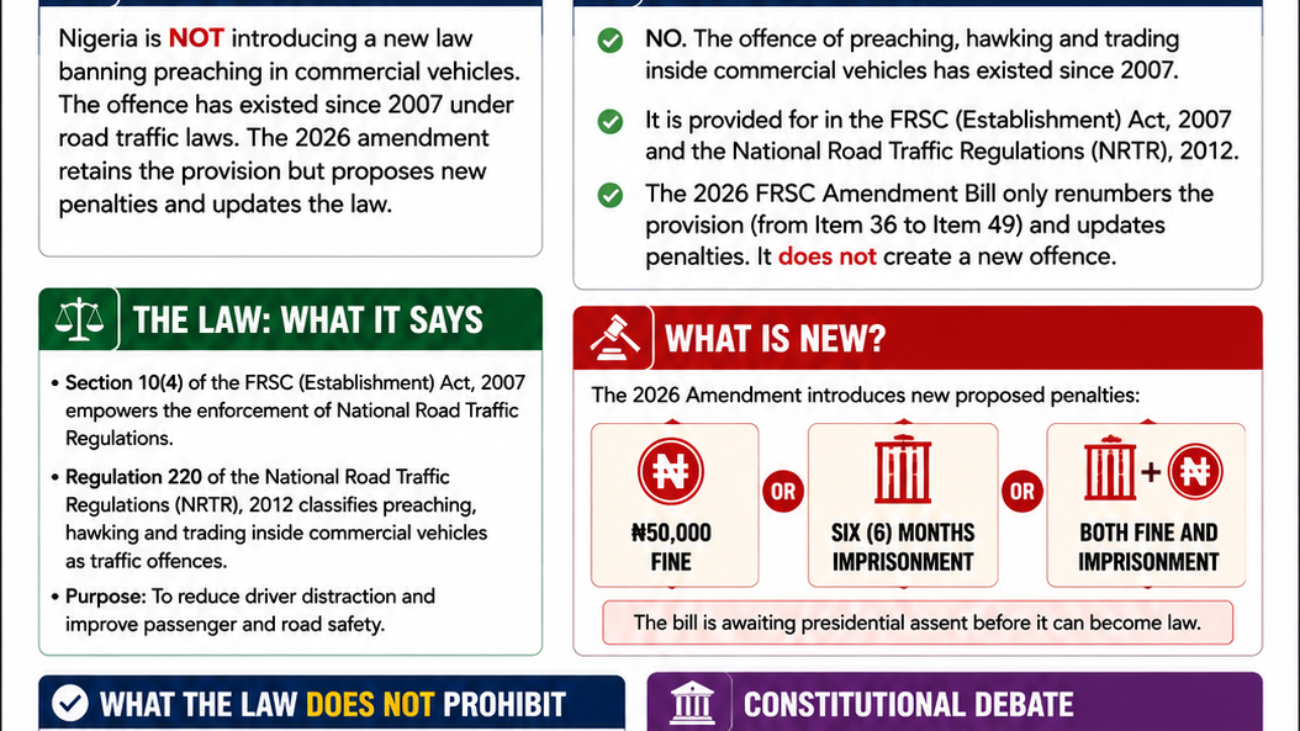
Nigeria is not introducing a new offence prohibiting preaching inside commercial vehicles. The prohibition has existed in the country’s road traffic laws for nearly two decades. What is new under the Federal Road Safety Commission (FRSC) Amendment Bill is the proposal to retain the existing offence while prescribing updated penalties and reorganising the legislation. (channelstv.com)
The Existing Law
The legal restriction originates from the Federal Road Safety Commission (Establishment) Act, 2007, which empowers the enforcement of the National Road Traffic Regulations.
Subsequently, the National Road Traffic Regulations (NRTR), 2012, specifically classify preaching, hawking and trading inside commercial vehicles as traffic offences. The objective is to minimise distractions capable of affecting drivers’ concentration and to improve the safety of passengers and other road users.
According to the Senate, the ongoing amendment merely renumbers the provision—from Item 36 in the existing law to Item 49 in the amended schedule—without creating a new offence. (channelstv.com)
Is This a New Law?
The answer is No.
Contrary to widespread claims on social media, the offence of preaching inside commercial vehicles did not originate from the 2026 amendment.
Instead:
- The prohibition has existed under the FRSC legal framework since 2007.
- It was further reflected in the National Road Traffic Regulations, 2012.
- The 2026 FRSC Amendment Bill simply preserves the provision while updating the overall law and proposing revised sanctions.
Therefore, describing the amendment as “a new law banning preaching in buses” is inaccurate. The offence is old; the amendment primarily updates the legal framework and penalties.
What Is New?
Although the offence itself is not new, the amendment introduces new proposed penalties.
Under the amendment passed by the National Assembly, anyone convicted of preaching, hawking or trading inside a commercial vehicle may be liable to:
- A fine of ₦50,000;
- Six months’ imprisonment; or
- Both fine and imprisonment, depending on the circumstances of the offence.
At the time of the Senate’s clarification, the amendment was awaiting presidential assent before becoming law. (punchng.com)
What the Law Does Not Prohibit
The law does not prohibit:
- Street preaching.
- Open-air crusades.
- Evangelism in markets or public places.
- Religious activities in churches, mosques or approved venues.
- Peaceful public expression of religious beliefs outside commercial vehicles.
The restriction applies only to activities conducted inside commercial vehicles, where authorities argue that such activities could distract drivers and compromise road safety.
Constitutional Debate
The amendment has nevertheless generated constitutional questions.
Religious organisations and some legal commentators argue that restricting preaching inside commercial vehicles may affect rights guaranteed under Sections 38 and 39 of the Constitution, which protect freedom of religion and freedom of expression.
On the other hand, supporters of the law maintain that constitutional rights are not absolute and may be reasonably regulated where public safety is involved. They argue that the restriction is comparable to other traffic regulations designed to prevent driver distraction and protect commuters.
Whether the restriction represents a reasonable limitation of constitutional rights would ultimately remain a matter for judicial interpretation should the issue reach the courts.
NewsNexus Analysis
The controversy demonstrates how incomplete reporting can fuel public misunderstanding of legislative developments.
Many headlines created the impression that the National Assembly had suddenly criminalised Christian and Islamic evangelism in public transport. However, available legal records indicate that the prohibition has existed for years within Nigeria’s road traffic regulatory framework.
The real policy issue is therefore not whether preaching has just been outlawed inside commercial vehicles—it has not. Rather, the debate concerns whether the existing restriction remains necessary, whether the proposed penalties are proportionate, and whether enforcement can be carried out without infringing constitutional rights.
As Nigeria continues to balance individual freedoms with public safety, lawmakers, religious bodies, transport unions and civil society organisations may need to engage in broader consultations to ensure that road safety objectives are achieved while maintaining public confidence in the protection of fundamental rights.
Conclusion
NewsNexus finds that claims suggesting Nigeria has enacted a new law banning preaching inside commercial vehicles are misleading. The prohibition has existed since the FRSC (Establishment) Act, 2007 and the National Road Traffic Regulations, 2012. The 2026 amendment does not create a new offence but seeks to retain the existing prohibition while introducing updated penalties and strengthening road traffic enforcement.
For Nigerians, the key distinction is important: there is no blanket ban on public or street preaching. The restriction applies specifically to preaching, hawking and trading inside commercial vehicles as part of Nigeria’s road safety regulations.

Leave A Comment