

By Abraham Maina Joda
Nigeria’s fuel subsidy debate has entered a new phase.
On May 29, 2023, President Bola Ahmed Tinubu announced the removal of petrol subsidy, declaring that “subsidy is gone.” The policy was justified as necessary to end a costly, opaque and unsustainable system that had encouraged import dependence, distorted the market and consumed huge public resources.
Three years later, however, the economic debate has become more complicated.
There is a strong argument that subsidy removal was necessary. But there is also growing concern that the speed and scale of the adjustment placed an enormous burden on ordinary Nigerians, while the expected benefits have not yet translated sufficiently into better living conditions.
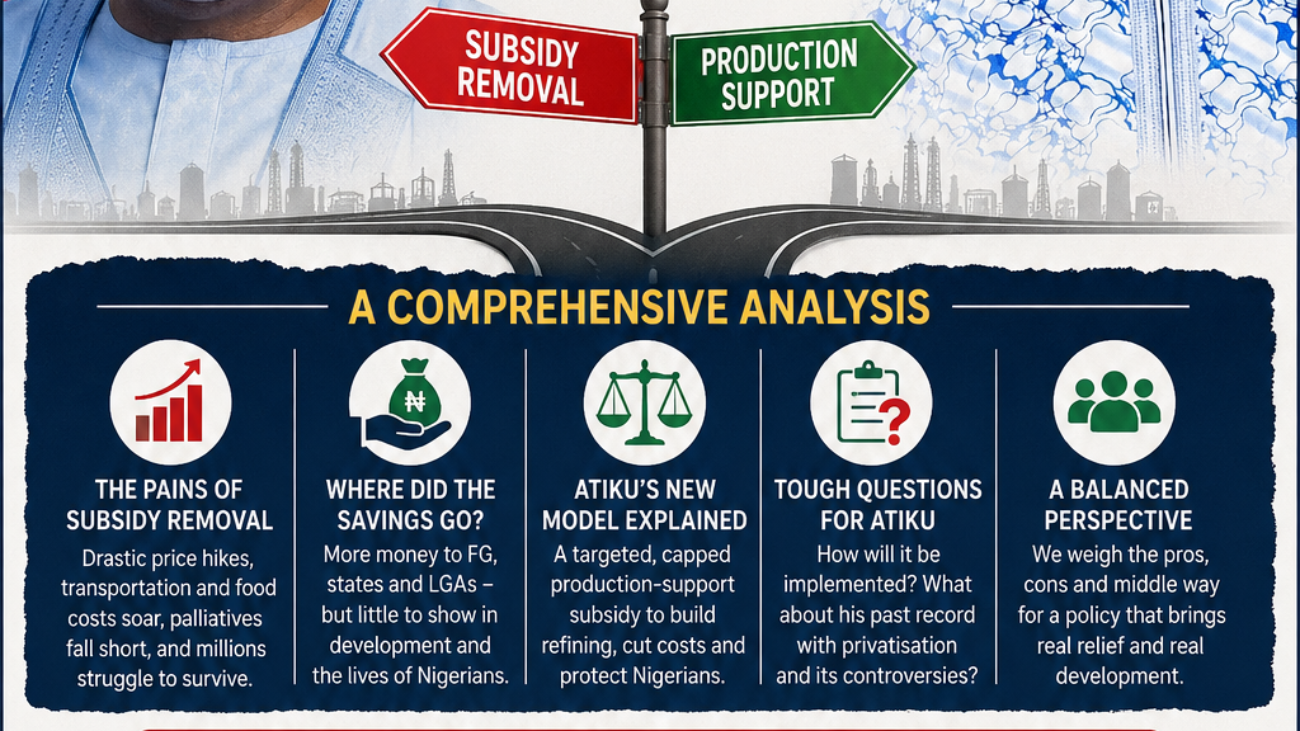
Against this background, former Vice President and ADC presidential candidate Atiku Abubakar has proposed a different model under his Atiku Economic Recovery Plan (AERP) 2027.
Atiku says he would not restore the old import-sub subsidy regime. Instead, his proposal would shift government support from imported petroleum consumption to domestic refining and production.
Qualifying refineries would receive Nigerian crude at a preferential price, but only if they meet production, efficiency, transparency and domestic-supply requirements. The subsidy would have a predetermined fiscal ceiling, independent auditing, consumer-benefit requirements and a sunset mechanism.
His philosophy is simple:
Target it. Cap it. Budget it. Track it. Audit it. Make Nigerians feel the benefit. Reduce it as domestic refining grows. And ultimately end the need for it.
The proposal is attractive in some respects. But it also raises serious economic, fiscal, legal, political and governance questions.
THE HUMAN COST OF SUBSIDY REMOVAL
The strongest argument against the present approach is not necessarily that subsidy removal was economically wrong.
It is that millions of Nigerians have borne an extraordinary cost in the process.
Petrol is not simply another commodity in Nigeria. Its price affects transportation, food distribution, agriculture, manufacturing, logistics and household expenditure.
The chain is straightforward:
Higher petrol prices → higher transport costs → higher distribution costs → higher food prices → lower purchasing power.
For many Nigerians, salaries have not risen at the same speed as the cost of living.
The consequences have been severe: higher transport fares, more expensive food, increased business operating costs and reduced household purchasing power.
The government has introduced palliatives and social interventions, but the central question remains whether they have been large enough, timely enough and sufficiently transparent to cushion the scale of the shock.
This is where the reform has suffered a serious legitimacy problem.
WHERE ARE THE BENEFITS OF SUBSIDY REMOVAL?
The fundamental promise of subsidy removal was that government would save money and redirect those resources towards development.
Additional revenue has indeed flowed through the Federation, benefiting the Federal Government, states and local governments.
But Nigerians are entitled to ask:
Where is the visible development dividend?
If governments now receive significantly more revenue, citizens should reasonably expect improvements in:
- roads;
- healthcare;
- education;
- security;
- public transportation;
- electricity;
- employment;
- social protection.
The concern is not necessarily that all the additional money has been stolen. That would be an unjustified generalisation.
The more important issue is accountability and development outcomes.
If more resources are available but the average Nigerian continues to struggle with food, transportation, housing and healthcare costs, government must explain how the additional revenue is being used.
Otherwise, there is a danger that Nigerians will conclude that the money has merely moved from one set of beneficiaries—the old subsidy interests—to another system controlled by political authorities without sufficient accountability.
The question should therefore be:
Has subsidy removal transferred resources from an inefficient subsidy system into productive national development, or has it simply transferred control of those resources without delivering enough public value?
That is a legitimate question for both the Federal Government and the states.
FROM INITIAL HOPE TO PUBLIC DISILLUSIONMENT
When subsidy removal was announced, many Nigerians accepted the argument that the old system could not continue.
There was an expectation that the sacrifice would eventually produce:
- stronger government finances;
- increased investment;
- domestic refining;
- reduced corruption;
- lower import dependence;
- better infrastructure;
- stronger economic growth.
But for many citizens, the perception has changed.
The question is no longer simply:
“When will the benefits come?”
It is increasingly:
“When will the hardship end?”
This does not automatically mean subsidy removal was economically wrong.
A reform can be macroeconomically necessary while socially painful.
The real test is whether government can convert the fiscal gains into measurable improvements in living standards.
ATIKU’S PRODUCTION-SUPPORT MODEL
Atiku’s proposal attempts to address precisely this weakness.
Instead of subsidising imported petrol, government would support domestic refineries by providing crude at preferential prices.
The intended chain is:
Nigerian crude → Nigerian refinery → Nigerian petroleum products → Nigerian consumers.
The refinery would not simply receive cheap crude and keep the benefit.
It would have to demonstrate:
- how much crude it received;
- how much it processed;
- how much petrol and diesel it produced;
- how much was supplied domestically;
- how the preferential crude price affected the final consumer price.
Any operator that diverts subsidised crude or products, falsifies records or fails to meet its obligations could lose eligibility and face repayment and legal sanctions.
This is significantly different from the old subsidy regime.
THE ECONOMIC CASE FOR ATIKU’S MODEL
The strongest argument in favour of the proposal is that it attempts to transform subsidy from consumption support into industrial policy.
Rather than using public resources primarily to make imported fuel cheaper, government would use limited support to expand domestic refining.
Potential benefits include:
- reduced fuel imports;
- lower foreign-exchange demand;
- greater energy security;
- domestic employment;
- increased industrial activity;
- reduced logistics costs;
- greater local value addition.
If properly implemented, this could make the intervention more productive than the old import subsidy.
But there is an important caveat.
Cheap crude is still a subsidy.
If government gives a refinery crude below its economic value, the difference represents a cost to the Federation.
Calling it “preferential crude” or “production support” does not eliminate that economic cost.
The real question is whether the economic benefits exceed the fiscal opportunity cost.
ATIKU MUST ANSWER THE COST QUESTION
Before Nigerians can fully embrace the proposal, Atiku needs to provide more detailed numbers.
How much will the programme cost annually?
How much will it cost over five years?
How much subsidy will be provided per barrel?
How much will consumers actually save per litre?
How much revenue will the Federation lose?
How much foreign exchange will be saved?
How many jobs will be created?
What happens if crude prices rise or fall dramatically?
And most importantly:
What prevents a refinery from receiving cheap crude while Nigerians continue paying expensive prices?
The proposal therefore needs a legally enforceable consumer-benefit formula.
THE PRIVATISATION QUESTION
Atiku’s proposal also deserves scrutiny because of his record as Vice President and Chairman of Nigeria’s privatisation policy during the 1999–2007 administration.
Privatisation was intended to improve efficiency, reduce government ownership and attract private investment.
Some transactions produced significant investments, but Nigeria’s privatisation history has also been marked by controversies, failed enterprises, disputed transactions and questions about whether some assets were transferred at appropriate values and to investors with sufficient capacity.
It would be unfair to claim without transaction-specific evidence that Atiku personally sold government assets cheaply to cronies or was responsible for every failure.
However, his central role in the privatisation programme makes it reasonable to ask:
What lessons from Nigeria’s privatisation experience have been incorporated into his proposed subsidy programme?
If government is once again transferring economic value—in this case, preferential access to public crude—to private operators, how will Nigerians be protected from political capture, favouritism and poor implementation?
The lesson should be clear:
Public resources must follow performance, not political connections.
THE PIA AND THE LEGAL QUESTION
Atiku’s proposal has an existing legal foundation in Nigeria’s Petroleum Industry Act (PIA), particularly its framework for domestic crude supply obligations.
The PIA already provides mechanisms for ensuring that domestic refineries have access to crude.
However, a domestic crude-supply obligation is not automatically the same thing as a government-funded subsidy.
A major programme involving the deliberate transfer of crude below its economic value would require clear fiscal and legal authority.
The safest structure would therefore involve:
- the PIA and its regulatory framework;
- additional legislation or statutory provisions where necessary;
- annual National Assembly appropriation;
- clear eligibility rules;
- independent auditing;
- NUPRC oversight of crude supply;
- NMDPRA monitoring of downstream supply;
- Ministry of Finance fiscal oversight.
An Executive Order could provide policy direction, but it should not be used to bypass parliamentary appropriation or create an open-ended fiscal obligation.
TINUBU’S MODEL VS ATIKU’S MODEL
| Issue | Tinubu’s approach | Atiku’s proposal |
|---|---|---|
| Basic philosophy | Market-based pricing | Market pricing + production support |
| Old blanket subsidy | Removed | Not proposed |
| Fiscal exposure | Lower direct subsidy exposure | New but capped exposure |
| Consumer impact | High adjustment cost | Intended to reduce cost |
| Domestic refining | Driven largely by market incentives | Supported by targeted intervention |
| Import dependence | Expected to decline | Deliberately targeted |
| Fiscal discipline | Stronger | Depends on strict ceiling |
| Risk of abuse | Lower than old subsidy | High unless tightly controlled |
| Social protection | Separate from fuel policy | Partly embedded in policy |
| Legal complexity | Lower | Higher |
| Long-term sustainability | Strong if market works | Depends on sunset and performance |
THE CASE FOR TINUBU
Tinubu’s greatest achievement in this area is that he confronted a system successive governments had struggled to reform.
Removing the blanket subsidy has improved the market signal for domestic refining and reduced the government’s direct exposure to an open-ended petrol price gap.
From a fiscal perspective, that is important.
But the weakness is equally clear:
The adjustment burden has fallen heavily on citizens.
A market-based fuel system cannot be considered a complete success simply because government spends less.
It must also demonstrate that citizens are eventually better off.
THE CASE FOR ATIKU
Atiku’s strongest idea is the shift from subsidising imports to supporting domestic production.
If properly designed, it could accelerate refining, reduce imports and create domestic economic value.
But his biggest risk is implementation and capture.
Nigeria has a long history of economic policies that look good on paper but become vulnerable to political interference, weak enforcement and rent-seeking.
Therefore, Atiku must demonstrate not only what he wants to subsidise, but how he will prevent the subsidy from becoming another avenue for private enrichment at public expense.
THE MIDDLE WAY
Nigeria does not have to choose between the old subsidy system and complete abandonment of government intervention.
A stronger policy could combine the best elements of both approaches.
Nigeria should:
1. Maintain market-based pricing
Do not return to the old blanket import subsidy.
2. Enforce the PIA’s domestic crude obligation
Ensure Nigerian refineries have access to crude.
3. Consider temporary production support
Where necessary to accelerate domestic refining.
4. Cap the fiscal exposure
The National Assembly should determine the maximum annual cost.
5. Make the subsidy decline
It should reduce as refining becomes commercially viable.
6. Guarantee consumer benefits
No cheap crude without measurable cheaper products.
7. Protect vulnerable Nigerians
Build permanent social protection instead of relying mainly on emergency palliatives.
8. Track every barrel and every naira
Government should publish regular accounts.
9. Maintain competition
No refinery should receive preferential treatment because of political connections.
10. End the subsidy when it is no longer necessary.
QUESTIONS FOR BOTH PRESIDENTIAL PROPOSALS
The debate should not become a political contest in which each side is asked questions while the other is excused.
Atiku should explain:
- How much will his subsidy cost?
- How will it be audited?
- How will consumers benefit?
- How will he prevent political capture?
- What lessons has he learned from Nigeria’s privatisation experience?
- When exactly will the subsidy end?
Tinubu should explain:
- How much has subsidy removal saved?
- How much additional revenue has accrued to the Federation?
- How much has gone to states and local governments?
- What proportion has been spent on palliatives?
- What development projects have been funded?
- Why have higher government revenues not translated into sufficient improvement in living standards?
- What is the government’s long-term plan for protecting Nigerians from energy-price shocks?
These are not partisan questions.
They are questions of public accountability.
CONCLUSION: NIGERIANS NEED RESULTS, NOT JUST REFORMS
Nigeria should not return blindly to the old subsidy regime.
But neither should the country accept a situation in which the removal of subsidy makes government finances healthier while millions of citizens become poorer and public services fail to improve sufficiently.
The central lesson is that economic reform must ultimately be judged by public welfare.
Tinubu’s reform may have addressed a genuine fiscal problem.
Atiku’s proposal offers an interesting alternative by shifting support from imported consumption to domestic production.
But neither approach should receive a blank cheque.
Atiku must prove that his production subsidy will not become another vehicle for political capture and private enrichment.
Tinubu must prove that the revenues and fiscal space created by subsidy removal are being translated into tangible development and improved living standards.
The best path may therefore be a disciplined middle ground:
Keep market pricing. Support domestic refining temporarily where necessary. Cap and budget any intervention. Protect vulnerable citizens. Track every barrel. Audit every naira. Maintain competition. Publish the results. And end the subsidy when Nigeria no longer needs it.
The ultimate objective should not be cheap petrol forever.
It should be a Nigeria where domestic refining is competitive, energy is affordable, government finances are sustainable, businesses can grow, and citizens can enjoy the benefits of the country’s natural resources.
Because Nigerians are not asking for the most ideologically perfect economic policy.
They are asking for policies that make their lives better.
— Abraham Maina Joda
NewsNexus Media
Research | Media | Public Policy | Strategic Communications
07038543606

Leave A Comment