

TARABA GOVERNMENT DEFENDS ITS POSITION, SAYS ASUU’S DEMANDS ARE GENUINE BUT PROCEDURE WAS ILLEGAL
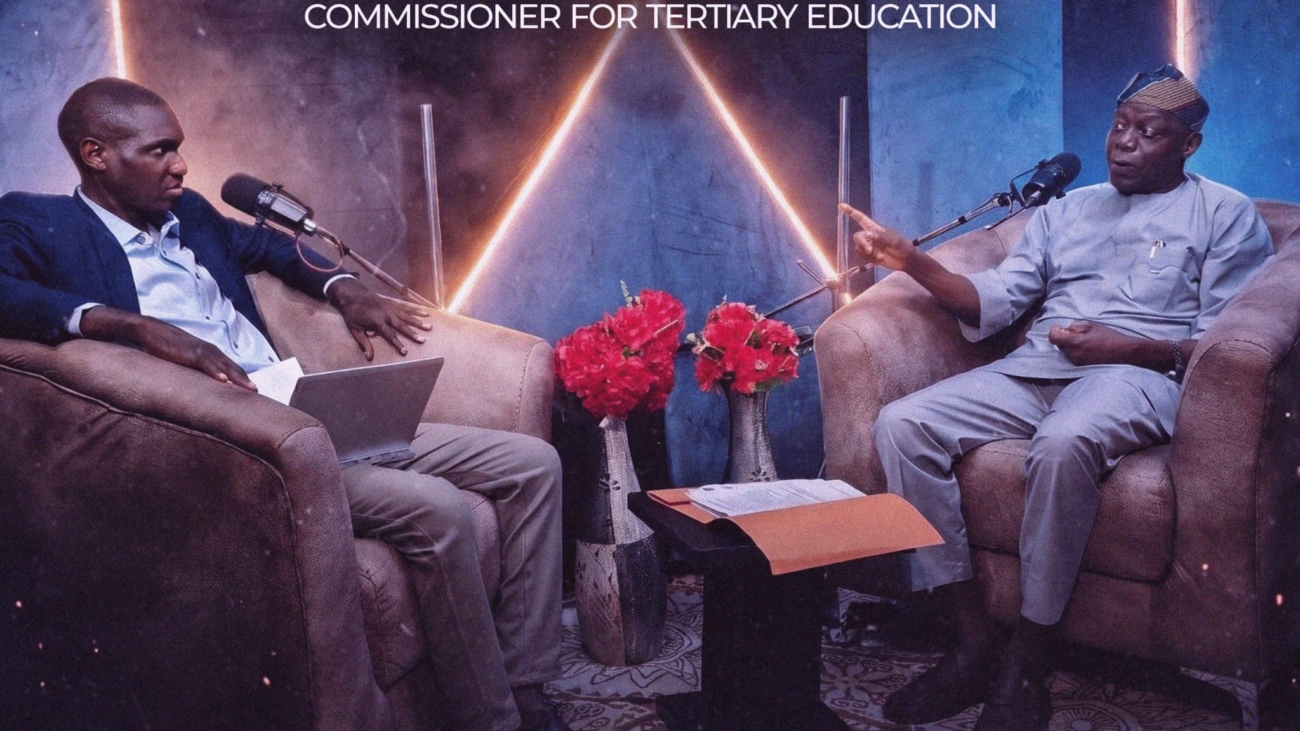
An Exclusive Interview with Dr. Mike Dio Jen, Commissioner for Tertiary Education, Taraba State
INTERVIEWER: ABRAHAM MAINA JODA
Ace Broadcaster, Editor-in-Chief and Chief Executive Officer, NEWS NEXUS MEDIA
The ongoing industrial action by the Academic Staff Union of Universities (ASUU), Taraba State University chapter, has generated considerable debate across Taraba State, raising concerns about workers’ welfare, government commitments, students’ academic futures, and the overall direction of the state’s tertiary education system.
In this exclusive edition of Hot Topics Podcast, ace broadcaster Abraham Maina Joda, Editor-in-Chief and Chief Executive Officer of NEWS NEXUS MEDIA, engages the Taraba State Commissioner for Tertiary Education, Dr. Mike Dio Jen, on the genesis of the industrial dispute, the government’s response to ASUU’s demands, the controversial declaration of the strike, and the administration’s proposed pathway towards resolving the impasse.
Dr. Jen speaks on the government’s financial commitments, the committee established to harmonise demands across tertiary institutions, his disagreement with the ASUU leadership over the procedure adopted in declaring the strike, and his appeal for the union to return to the negotiation table.
Below are excerpts from the interview.
QUESTION 1: Can you take us through the genesis of the ongoing industrial dispute between ASUU and the Taraba State Government?
DR. MIKE DIO JEN: Thank you very much for the opportunity to explain my side of the issue.
The strike declared by ASUU, Taraba State University chapter, is not an entirely new development. The union had previously embarked on industrial action around March, April, and May over several issues.
One of the major issues at the time was the accumulated salary arrears arising from the previous administration’s declaration of a no-work-no-pay policy. This resulted in approximately 12 months of outstanding salaries, alongside earned academic allowances amounting to over ₦3 billion.
When the present administration came on board, His Excellency promised to address these outstanding obligations.
In fulfilling that commitment, the governor commenced payments towards the accumulated arrears. Out of the approximately ₦2 billion outstanding salary arrears, the government paid ₦1 billion. Similarly, out of the approximately ₦1.8 billion accumulated earned academic and administrative allowances for academic and non-academic staff, the government also paid ₦1 billion.
The governor subsequently released another ₦500 million and promised to pay ₦100 million monthly until the outstanding obligations were fully settled.
He has continued to honour that commitment. In July, for instance, he released ₦200 million to cover July and August.
QUESTION 2: What happened when the issues of CATA and CONTA were introduced, and what steps did the government take?
DR. MIKE DIO JEN: When the unions presented their demands concerning CATA for academic staff and CONTA for non-academic staff in August, we immediately took steps to address the matter.
Within two days, we convened a meeting at the Ministry of Higher Education and resolved that the matter required urgent attention.
We communicated with the Head of Service, requesting the establishment of a committee involving the ministry and the unions.
The committee was subsequently constituted, with ASUU representatives participating.
One of the resolutions was that representatives should visit neighbouring states within the North-East to investigate how similar allowances were being implemented. They also extended their investigations to Kaduna State University, where they obtained payslips, payroll records, and other relevant information.
The representatives returned with their findings. However, as I speak to you, ASUU has yet to submit its findings to the committee.
Meanwhile, other unions across the state’s six functional tertiary institutions also presented their demands. These include Taraba State University, Taraba State Polytechnic, College of Agriculture, Science and Technology, Suntai College of Education, Zing, the College of Nursing and Midwifery, and the College of Health Technology.
The non-academic staff union at the university also presented its demands.
Consequently, the governor decided that the matter should not be handled piecemeal. He wanted all the demands harmonised so that the government could establish the total monthly financial implications.
He therefore directed the establishment of a committee headed by the Secretary to the State Government, with representatives drawn from the various unions.
In fact, two-thirds of the committee’s membership consists of union representatives. This ensures that their interests are represented in the decision-making process.
QUESTION 3: You described the manner in which ASUU declared the strike as unconstitutional. Can you substantiate that position?
DR. MIKE DIO JEN: I was once a union leader, and I understand the provisions of labour law.
There are procedures that a union is expected to follow before embarking on industrial action.
First, the union must attempt negotiations with its employer through collective bargaining.
If negotiations fail, the dispute should be reported to the Federal Ministry of Labour and Productivity for intervention and reconciliation.
If reconciliation fails, the matter can proceed to the Industrial Arbitration Panel before a strike can legitimately be declared.
I am referring to the provisions contained in Section 18, including Subsections 1(c), 2, and 3, of the relevant labour legislation.
I also have a document from the Ministry of Labour and Productivity indicating that the ministry cautioned the union over embarking on the strike without notifying it.
The ministry appealed to the union to suspend the strike and continue negotiations in the interest of the state and the students.
My position was that the procedure adopted in declaring the strike was unconstitutional. I was not necessarily saying that the demands themselves were illegitimate.
QUESTION 4: The ASUU leadership has also made arguments concerning the welfare of students and compared the situation to doctors abandoning patients during industrial action. What is your response?
DR. MIKE DIO JEN: My question to the ASUU chairman is this: if a doctor is performing an emergency operation on a patient who is about to die, can that doctor abandon the patient simply because a strike has been declared?
Can a doctor abandon someone in the middle of surgery?
That is the question I want him to answer.
I also want to make something very clear: ASUU’s demands are genuine. We acknowledge that, and the governor acknowledges it too.
However, the manner in which these demands are being handled raises questions.
We have never stopped pursuing their implementation. We have continued discussions, approached the governor, and obtained approval for the package.
As I speak, I have documents showing that the governor’s approval was communicated to the university. The document was acknowledged by the Vice-Chancellor.
Therefore, when the ASUU chairman says they were unaware of the government’s position, I believe the relevant documents should be examined.
QUESTION 5: There appears to be a disagreement between you and the ASUU chairman, particularly concerning your public statements. Is this becoming a personal disagreement?
DR. MIKE DIO JEN: I was a union leader, and I understand that unionism is different from activism.
Unions are partners in progress with government. Their members are workers, and they have legitimate interests to protect.
However, union leadership requires responsibility. Official statements should reflect the position of the union and should be properly scrutinised.
During my time in union leadership, before any statement was issued, the congress examined it line by line because statements can have serious implications.
I therefore wonder whether the current situation reflects collective union leadership or individual decisions.
I also want to emphasise that I did not speak as Mike Dio Jen personally. I represented the government.
Before addressing the press, I stated clearly that the governor had directed me to speak on his behalf.
Therefore, the issue should not be personalised.
When pursuing a cause, people should avoid sentiments and personal attacks. They should focus on their mandate and objectives.
QUESTION 6: What exactly is the government doing to resolve the dispute, and how soon can the outstanding demands be implemented?
DR. MIKE DIO JEN: As I explained earlier, His Excellency granted approval to the package on the 3rd of October, and that approval was communicated to the union.
What the government wants is for representatives of all the unions across the tertiary institutions to work with government officials to establish the actual financial implications of their demands.
These institutions operate different salary structures.
For instance, the salary structure of academic staff differs from that of non-academic staff, even within the university. The same applies to the Colleges of Education, Nursing, and other tertiary institutions.
The government therefore wants the unions to harmonise these differences and present the total cost of implementation.
That is the purpose of the committee.
If there is any delay, the committee’s work needs to be expedited.
Interestingly, when the committee headed by the Secretary to the State Government was established, ASUU indicated that it would not participate.
Yet, the union subsequently returned to attend committee meetings, and we have their attendance records.
My position is that they should suspend the strike, return to the negotiation table, and insist that the discussions be concluded within an agreed timeframe.
The government is prepared to implement the approved package once the necessary processes are completed.
QUESTION 7: What is your appeal to ASUU at this point, particularly considering the impact of the strike on students?
DR. MIKE DIO JEN: I want to use this opportunity to appeal to my colleagues.
They are intelligent and hardworking people, and we understand that their welfare is important in enabling them to perform their duties.
I assure them that this government is serious about education. Education remains a top priority of this administration, which is why the government continues to invest significantly in the sector.
I appeal to them to suspend the strike.
ASUU communicated to us that it would not suspend the strike until the allowances were paid. However, that is not how the process should work.
When government approval has been granted, the union should return to the negotiation table and allow the implementation process to be concluded.
You cannot hold government to ransom by insisting that every kobo must be paid before calling off the strike.
More importantly, we must consider the students.
Some students who were writing their final examinations had only one paper remaining. They are now stranded in town, uncertain about when the strike will end.
Some of them come from distant communities such as Gembu, Sardauna, Kurmi, and other locations. They cannot even plan their journeys home because they do not know when academic activities will resume.
Some have exhausted the money available to them.
Let us consider their situation and allow them to complete their examinations.
I assure ASUU that the government has approved the package and is committed to making the payments.
They should return to the committee and expedite the process of determining the total financial implications.
If the process is not completed, what exactly do you expect the governor to pay?
That is the fundamental question.
QUESTION 8: Before we conclude, what final message do you have for lecturers and other unions across Taraba State’s tertiary institutions?
DR. MIKE DIO JEN: I want to appeal to the conscience of lecturers across all tertiary institutions.
Yes, strikes are part of the struggles of trade unions, but a strike should not be the first option. It should ordinarily be the last resort.
There are other approaches, particularly lobbying, especially because we are operating in a democratic system.
I encourage them to embrace the culture of lobbying. Through lobbying, you can achieve many things you may not have initially envisaged.
Confrontation will never solve the problem.
I am not appealing to ASUU alone. I am appealing to all unions across the tertiary institutions in Taraba State.
Let us work together.
During my time as a provost, which lasted seven years and ten months, my staff never embarked on strike.
CLOSING REMARKS
ABRAHAM MAINA JODA: Thank you very much, Dr. Jen, for granting us this opportunity and providing these insights.
I believe we will still have you on this programme again.
This brings us to the end of this important and insightful edition of Hot Topics Podcast.
We appreciate your time and willingness to address the issues surrounding the ongoing industrial dispute.
To our viewers, we thank you for joining us as we continue to bring you topical issues, hot and sizzling.
We call on all parties involved in this dispute to find common ground and resolve the disagreement with a human face, in the interest of the welfare of all Tarabans.
My name is Abraham Maina Joda, popularly known as The Truth Finder, ace broadcaster, Editor-in-Chief, and Chief Executive Officer of NEWS NEXUS MEDIA.
This is HOT TOPICS PODCAST.
Have a wonderful day.

Leave A Comment