

Maiden Edition of the Quarterly Revenue Performance Review of Ministries, Departments and Agencies
By Abraham Maina Joda
NewsNexus Media | Research | Media | Public Policy | Strategic Communications
August 27, 2026
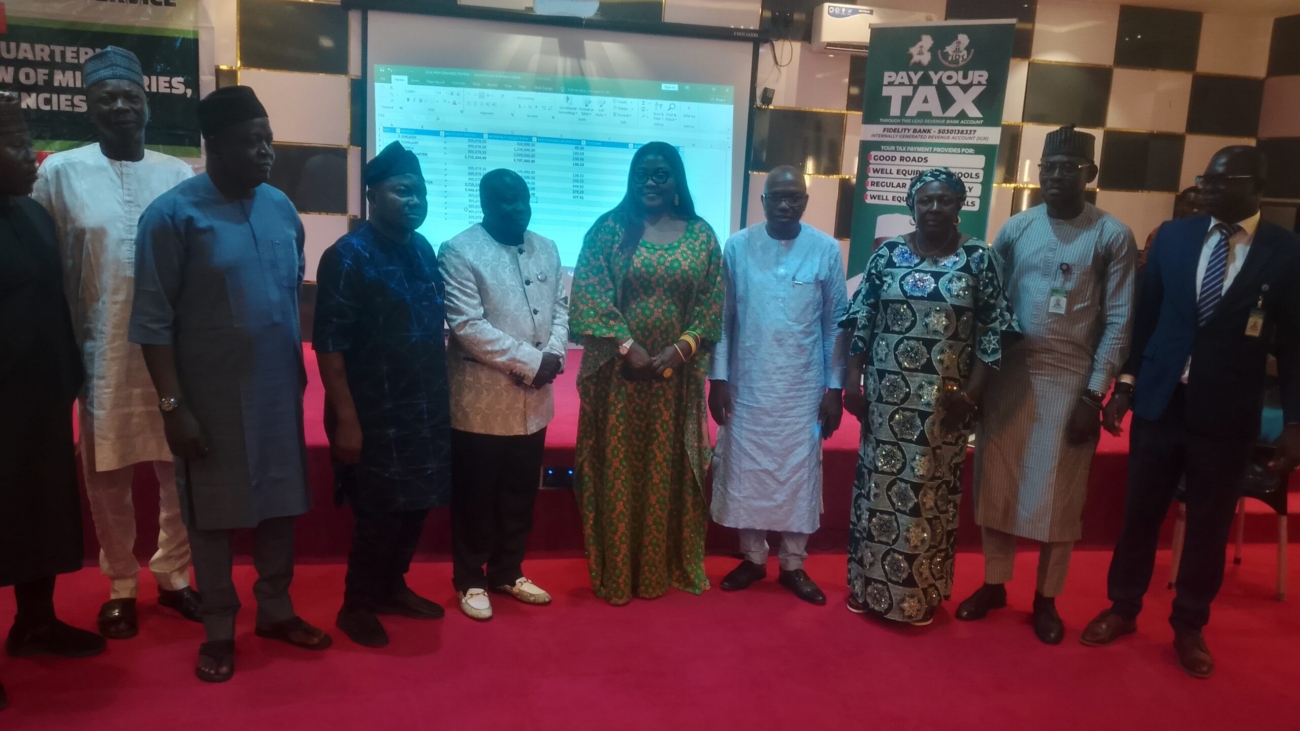
The Taraba State Ministry of Finance, Budget and Economic Planning, led by the Honourable Commissioner, Mrs. Sarah Enoch Adi, in conjunction with the Taraba State Internal Revenue Service (TIRS) under the leadership of its Executive Chairman, Brig. Gen. Jeremiah Aliyu Faransa (Rtd.), FCNA, ACTI, has commenced a new era of institutional revenue accountability with the maiden edition of its Quarterly Revenue Performance Review of Ministries, Departments and Agencies (MDAs), bringing together 22 government institutions to examine revenue targets, actual collections, performance gaps and challenges affecting internally generated revenue.
The review, held on Wednesday, August 26, 2026, in Taraba State, was therefore jointly driven by the Ministry of Finance, Budget and Economic Planning and TIRS, with the Ministry providing the broader policy and fiscal leadership while TIRS provided the revenue administration and performance-monitoring framework.
Among those in attendance was the Commissioner for Finance, Budget and Economic Planning, Mrs. Sarah Enoch Adi, alongside the Permanent Secretary of the Ministry, Douglas Kisawa.
Also present were the Chairman of Taraba Investment Company, Jubril Husseni; Permanent Secretary, Ministry of Agriculture, Hon. Aminu Kotolo; Permanent Secretary, Civil Service Commission, David Nyang; the Accountant-General of the State, Gaius; members of the TIRS Board, including Mr. Theophilus Japheth and Mr. Magai Angyo, as well as other permanent secretaries, directors and revenue officers.
A New Culture of Revenue Accountability
Opening the maiden review, the TIRS Executive Chairman, Brig. Gen. Faransa, said the initiative was designed to establish a stronger culture of performance measurement, accountability, transparency and collective responsibility in the management of government revenue.
Faransa stressed that revenue generation should not be regarded as the exclusive responsibility of TIRS.
According to him, every revenue-generating MDA has a responsibility to ensure that revenue due to government is properly identified, assessed, collected, accounted for and remitted.
The quarterly review, he explained, is not intended to witch-hunt institutions that are performing below expectations, but to provide government with a clearer understanding of where revenue is being generated, where gaps exist and what practical interventions are required to improve performance.
He also identified data, technology, monitoring and collaboration as critical components of a modern revenue administration system.
The initiative is expected to provide government with a regular mechanism for measuring institutional performance rather than waiting until the end of the financial year before identifying revenue shortfalls.
₦59.5 Billion 2026 Revenue Target
A presentation by TIRS Board Member Mr. Theophilus Japheth provided a broader picture of Taraba State’s revenue position for 2026.
According to the presentation, TIRS has been assigned an annual internally generated revenue target of approximately ₦46 billion, while other revenue-generating MDAs are expected to contribute approximately ₦11.5 billion.
This brings the state’s collective 2026 revenue target to approximately ₦59.5 billion.
Japheth said the target was based on the revenue potential available to the state and should therefore not be regarded as an unrealistic projection.
He argued that Taraba possesses significant resources and economic activities capable of generating considerably more revenue if properly identified, monitored and harnessed.
First-Half Performance Raises Concern
The figures presented at the review, however, revealed a significant gap between the state’s revenue expectations and actual collections during the first half of 2026.
For the first quarter, covering January to March, the state recorded approximately ₦4.2 billion against a quarterly benchmark of about ₦11.5 billion.
This represented approximately 36 percent of the quarterly target.
Performance improved marginally in the second quarter, covering April to June, when approximately ₦4.4 billion was collected against the same quarterly benchmark of ₦11.5 billion.
The combined collection for the first two quarters therefore stood at approximately ₦8.6 billion, against a six-month benchmark of about ₦23 billion.
This translates to an overall first-half performance of approximately 38 percent.
The figures were presented as a significant warning signal and a basis for renewed efforts to identify the structural and operational factors responsible for the revenue gap.
Japheth described the situation as one requiring serious reflection, stressing that the state has the capacity to perform better if it changes its approach to revenue generation and administration.
80 Percent Performance Expectation
In setting the framework for presentations by the participating MDAs, TIRS Board Member Mr. Magai Angyo said every institution was expected to provide a clear and consistent account of its revenue performance.
Each MDA was required to present:
1. Its annual revenue target;
2. Monthly revenue targets;
3. Actual monthly collections;
4. Percentage of target achieved;
5. Comparison between actual collections and targets;
6. Major challenges affecting performance; and
7. Proposed way forward.
According to Angyo, the review would work with an expectation that MDAs should have achieved at least 80 percent of their expected performance benchmark by the end of the first half of the year.
The emphasis, he said, was not merely on the figures but also on understanding the reasons behind any shortfalls.
Presentations were limited to approximately six minutes per MDA, with one or two questions or observations permitted after each presentation.
The streamlined format was designed to make the review more efficient while ensuring that management could quickly identify areas requiring intervention.
Commissioner Calls for Change of Mindset
In her keynote address and formal declaration of the review open, the Commissioner for Finance, Budget and Economic Planning, Mrs. Sarah Enoch Adi, called for a fundamental change in the way government institutions approach revenue generation.
She acknowledged that some progress had been made but maintained that the state’s revenue performance still required significant improvement.
The Commissioner said the decline in revenue performance presented a major challenge that required stronger revenue analysis, improved collection strategies and better implementation of government policies.
She urged government officials to accept responsibility for both successes and shortcomings, stressing that revenue remains fundamental to the state’s ability to provide infrastructure and public services.
Mrs. Enoch also emphasised the importance of ensuring that every revenue due to government is properly assessed, collected and accounted for.
She called for greater adoption of technology, innovation, knowledge and transparency in revenue administration.
According to her, digital revenue platforms can improve transparency, reduce human interference, make payments more convenient for taxpayers and provide government with timely and reliable information for decision-making.
The Commissioner described the quarterly review as more than a revenue meeting, saying it should serve as a platform for learning, accountability and renewed commitment to improving Taraba’s financial position.
Technology and the End of Cash-Based Revenue Collection
One of the significant features of the review was a demonstration of the TIRS electronic payment and revenue automation platform by i4CUS Nig. Ltd.
The demonstration highlighted the Service’s movement away from cash-based revenue collection and towards electronic payment and automated revenue tracking.
TIRS officials reiterated that the Service no longer collects revenue through cash, with electronic payment mechanisms being promoted to reduce leakages, improve transparency and strengthen accountability.
The digital approach is also expected to make it easier for government to track collections in real time and identify discrepancies between assessments, collections and remittances.
Real-Time Reconciliation with TIRS
Another major issue emerging from the review was the need for real-time reconciliation between MDAs and the Taraba Internal Revenue Service (TIRS).
Participants identified communication gaps and discrepancies in revenue information as issues requiring stronger coordination.
Real-time reconciliation, if effectively implemented, could enable relevant government institutions to work with more accurate and timely revenue information, improve reporting and reduce inconsistencies in revenue records.
The proposal reflects a broader recognition that effective revenue administration increasingly depends on the integration of data across government institutions.
22 MDAs Participate
The maiden review brought together 22 Ministries, Departments and Agencies, reflecting the state’s attempt to create a more coordinated revenue ecosystem.
Participating institutions included:
– Taraba State Internal Revenue Service (TIRS)
– Taraba State Geographic Information Service (TAGIS)
– Ministry of Agriculture
– Ministry of Commerce, Trade and Industry
– Ministry of Social Justice
– Ministry of Environment and Climate Change
– Ministry of Works and Infrastructural Development
– Taraba State Bureau of Statistics
– Ministry of Women Affairs
– Ministry of Justice
– Ministry of Digital Economy and Innovation
– Ministry responsible for Urban Development
– Bureau of Public Procurement
– Taraba Television (TTV)
– Taraba State Livestock Commission
– Ministry of Waste Management
– Ministry responsible for Rural and Urban Development
– Other revenue-generating MDAs and institutions.
Their participation provided an opportunity to begin comparing revenue expectations with actual collections across different sectors of government.
Five-Year Revenue Ambition
Looking beyond 2026, the review also examined a five-year revenue outlook targeting approximately ₦60 billion annually in internally generated revenue.
While the projection is ambitious, TIRS Board Member Theophilus Japheth argued that it could be achieved if the state adopts a different approach to revenue mobilisation.
This would require stronger monitoring, better data, improved compliance, identification of untapped revenue sources and closer collaboration between TIRS and the various MDAs.
The objective is not simply to increase taxation but to ensure that economic activities and government revenue sources are properly captured within a transparent and efficient system.
Revenue and Taraba’s Fiscal Challenge
The review also drew attention to the wider fiscal position of Taraba State.
Japheth noted that government expenditure remains significantly higher than internally generated revenue and funds received from the central government, contributing to fiscal pressure and the state’s fiscal deficit.
Increasing internally generated revenue, therefore, is not merely a matter of improving the revenue figures.
It is directly linked to the state’s ability to strengthen its fiscal position, improve budget implementation, sustain public services and create greater room for development planning.
What the Review Means for Taraba
The significance of the maiden Quarterly Revenue Performance Review lies in its attempt to shift revenue administration from an occasional exercise to a continuous performance-monitoring system.
Rather than waiting for annual reports to reveal revenue failures, the quarterly approach gives government the opportunity to identify problems early, question performance, address institutional weaknesses and pursue emerging revenue opportunities.
It also places greater responsibility on MDAs that generate or administer government revenue.
For the Ministry of Finance, Budget and Economic Planning, the exercise provides an important policy and fiscal oversight mechanism. For TIRS, it creates a platform to monitor performance across the revenue chain. For the MDAs, it introduces a stronger expectation of measurable results, transparent reporting and accountability.
The challenge, however, will be to ensure that the review does not become another bureaucratic meeting that produces figures without corresponding action.
The real test will be whether the identified challenges are addressed, whether revenue leakages are reduced, whether compliance improves and whether subsequent quarters demonstrate measurable progress.
TIRS Board Calls for Adoption of Best Practices
In his closing remarks, Mr. Idi Andrew Ivo, Executive Director and Board Member of TIRS, urged the participating MDAs to key into the best practices being promoted by the Revenue Service as part of efforts to strengthen revenue administration across the state.
Ivo emphasised the importance of embracing technology and the TIRS electronic payment (E-Payment) system, noting that the adoption of modern revenue collection tools would improve transparency, accountability, efficiency and the tracking of government revenue.
He encouraged the MDAs to work closely with TIRS and align their revenue administration processes with the reforms and systems being introduced by the Service.
The TIRS Board Member also stressed that Taraba State has enormous revenue potential, urging all stakeholders to work together to unlock those opportunities and ensure that the state reaches greater heights in revenue generation.
He said the task of improving revenue performance requires collective commitment from the government, TIRS and all revenue-generating MDAs.
His closing remarks reinforced the central message of the maiden review: that achieving stronger revenue performance will require not only setting ambitious targets, but also adopting better systems, embracing technology and working collectively to convert Taraba’s enormous economic potential into sustainable public revenue.
The Road Ahead
Taraba’s first-half revenue performance of approximately ₦8.6 billion against a ₦23 billion six-month benchmark presents a substantial gap.
But the review also presents an opportunity.
The state’s revenue potential cannot be converted into public resources merely through the setting of targets. It requires accurate data, efficient systems, taxpayer confidence, institutional coordination, technology, enforcement, transparency and political and administrative commitment.
The maiden quarterly review has therefore placed the figures before the institutions responsible for generating and administering public revenue.
The next step is action.
For Taraba to move towards the projected ₦59.5 billion 2026 revenue target and the longer-term ambition of approximately ₦60 billion annually, the Ministry of Finance, Budget and Economic Planning, TIRS and the participating MDAs will need to transform the review process into measurable improvements in collection, compliance and accountability.
The success of the initiative will ultimately be determined not by the quality of presentations delivered at the quarterly meetings, but by the revenue actually reaching the treasury and the development outcomes those resources help to finance.
NEWSNEXUS will continue to track Taraba State’s revenue performance, MDA-level collections, emerging revenue reforms and the implementation of recommendations from the quarterly review.
By Abraham Maina Joda
NewsNexus Media
Research | Media | Public Policy | Strategic Communications
NewsNexus.ng

Leave A Comment